Quick Review
to a T makes a teenager's everyday routines part of an odd, warm coming-of-age story, complete with a helpful dog and an unusually capable sandwich giraffe. Music, characters and small acts of support give its strange premise emotional substance. Light, disconnected activities and awkward camera navigation make playing less consistently delightful than discovering the story. It is best for fans of unusual narrative adventures who can accept simple mechanics and an eccentric, divisive direction.
In this review
Reasons to look closer · Breakfast makes the premise practical · A small town with a generous nonsense budget · The songs do more than fill the gaps · A warm welcome is not the same as easy handling · Verdict: An endearing oddity with uneven things to do · Sources
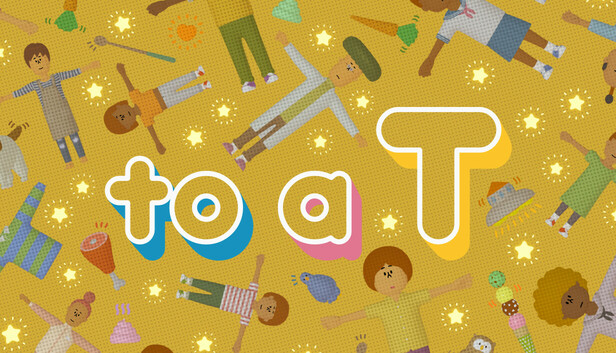
to a T takes a familiar teenage problem, feeling different from everybody around you, and gives it a very literal silhouette. Teen is thirteen, lives in a seaside town and cannot lower their outstretched arms. Life still includes breakfast, school, shopping and a wonderfully helpful dog. Keita Takahashi and uvula’s adventure fully released on May 28, 2025 [1]. It is a strange, kindly story about getting through the day, in a town where a sandwich-making giraffe is apparently a perfectly normal local business.
The appeal lies in that combination of everyday tenderness and complete nonsense. Rather than treating Teen as a problem to be solved, the premise makes room for their routines, relationships and personality. Its weakness is that delightful ideas do not automatically produce delightful interaction. Some activities are slight, and contemporary criticism repeatedly separates the pleasure of discovering the story from the awkwardness of moving through it. Come for the characters and surprises; do not expect Katamari Damacy’s wonderfully concentrated mechanical hook in a different outfit.
Reasons to look closer
There is something appealingly specific here: an episodic coming-of-age adventure where small practical tasks share space with musical numbers and cheerful absurdity. It is worth a look if character, tone and an unusual point of view matter more to you than demanding puzzles. The humour also has enough oddness to avoid becoming a bland motivational poster. Less patient players may find the stretches between story developments thin. This is a storybook you help along, not a systems-heavy playground that happens to contain a touching message.
Breakfast makes the premise practical
The everyday minigames ask you to move Teen’s arms and control small actions such as eating [5]. That is a useful choice of scale. A character’s relationship with the world can emerge from an ordinary morning more clearly than from a lengthy explanation of what makes them different. Getting ready is not merely a montage before the real adventure; it helps establish how this person lives. The dog’s assistance also makes support part of the household, rather than a special lesson wheeled out for one scene.
GameSpot’s Steve Watts praised the writing around bullying and the way its effects follow Teen beyond the schoolyard [6]. That gives the brighter domestic moments something to contrast with. The game is interested in a person whose day contains both comfort and anxiety, not just an amusing shape. Its most persuasive emotional idea is simple: an ordinary routine can require ingenuity, and receiving help does not make the person living that routine less complete. The sandwich giraffe is a bonus, not the entire point.
A small town with a generous nonsense budget
Walking, train journeys and unicycle travel [2] connect Teen with the town and its unusual residents. Free exploration adds shops, clothing and things to discover around the main story. The setting’s ordinary structure matters as much as the odd residents: a school day and a familiar neighbourhood give the nonsense somewhere to land. Surreal details become funnier when everybody carries on as though the local planning department approved them years ago. A speaking animal is less surprising when it also has opening hours.
The optional coin collecting and wardrobe choices offer a reason to poke around, but they are light diversions rather than a deep progression system. Watts found the overall collection of activities mechanically disjointed [6], despite enjoying the characters and presentation. That criticism gets to the central trade-off. A place can be lovely to spend time in without constantly giving you interesting decisions. If you need each excursion to expand a puzzle, test a skill or unlock a substantial new possibility, the pleasant errands may not be enough.
The songs do more than fill the gaps
The episodic structure gives musical sequences room to become a recurring part of the storytelling. PC Gamer’s Christopher Livingston singled out the theme song’s changing context [7]: upbeat music accompanies different circumstances, so the same familiar tune does not always have the same emotional effect. That is more interesting than using a catchy number as a permanent stamp saying everything is adorable. Repetition can carry meaning when the situation around it shifts. It can also leave your internal jukebox under new management.
The cartoon-like characters and gentle visual language work alongside that music, but the humour is not restricted to carefully sanitised sweetness. There are bodily-function jokes, strange encounters and developments best left undisclosed. The useful expectation is a playful fable with surprises, rather than a realistic account of adolescence. That frees the game to be peculiar and funny. It also means that anyone hoping for a consistently grounded treatment of its themes will eventually have to decide how far they want to follow the detour.
A warm welcome is not the same as easy handling
An important reservation concerns navigation rather than Teen’s fictional circumstances. In his PC review, Livingston found camera framing and obstructions made getting around unnecessarily awkward [7]. A character adapting to an unusual body is part of the premise; a player struggling to see where they are going is a separate design problem. The distinction matters. A game should not receive automatic credit for every inconvenience simply because its story is about a world that does not always accommodate its protagonist.
That concern also appears in Nintendo Life’s June 2026 Switch 2 review [8], which criticised the camera and limited accessibility options. Its reviewer, Michelle See-Tho, also felt the later narrative turn weakened the acceptance theme, whereas PC Gamer enjoyed the surprising story. This disagreement between video game reviews is useful without revealing the twist: the eccentricity is not merely decoration, and its eventual direction will not work for everyone. A friendly tone is not a guarantee of straightforward controls or a universally satisfying emotional conclusion.
Verdict: An endearing oddity with uneven things to do
to a T is easiest to recommend as a compact character adventure whose personality outweighs its mechanical ambition. The supportive home, uncomfortable school experience and gleefully peculiar town give Teen more to be than a visual gag. Music helps the story find an identity of its own, and the everyday actions make its central idea tangible. Those are worthwhile accomplishments to weigh when indie game reviews divide over a story’s charm and its mechanical limitations. They do not require pretending that every minigame is compelling or every walk between conversations is an inspired piece of interaction.
Choose it if you enjoy unusual narrative games and can accept simple activities in exchange for a distinctive voice. Approach more cautiously if navigation friction frustrates you, if accessibility settings are a priority, or if you want the playful precision associated with Takahashi’s best-known work. There is real warmth here, but warmth is not the same as polish. The strongest reason to visit is meeting a memorable teenager and seeing where this very odd story goes. The giraffe can handle lunch; expectations are the part worth packing carefully.
Sources
Source links correspond to the numbered references in this review.
[1] Steam — full release, official developer/publisher/genre/mode and Windows requirements • [2] Annapurna — official narrative premise and developer credit • [3] Xbox — official Series X|S/PC release and single-player support • [4] PlayStation Store — official PS5 version, release date and Adventure genre • [5] Nintendo — native Switch 2 release June 11, 2026, and official gameplay features • [6] GameSpot — Steve Watts, to a T review (May 29, 2025) • [7] PC Gamer — Christopher Livingston, to a T review (May 28, 2025) • [8] Nintendo Life — Michelle See-Tho, to a T Switch 2 review (June 11, 2026)