Quick Review
Tiny Bookshop connects a gentle retail routine with becoming part of a seaside community. Choosing stock, arranging decorations and recommending actual books make customers feel like people rather than sales totals. Much of the selling is passive, and repeated days or requests your stock cannot satisfy may frustrate more demanding managers. It is an inviting choice for readers who enjoy decorating, small stories and ordinary kindness, rather than deep economic optimisation.
In this review
Reasons to look closer · Opening up is a ritual, not an endurance test · The right book is not always on your shelf · A decorative skull is also a business decision · The customers gradually become the reason to return · A cosy recommendation with a little retail attached · Sources
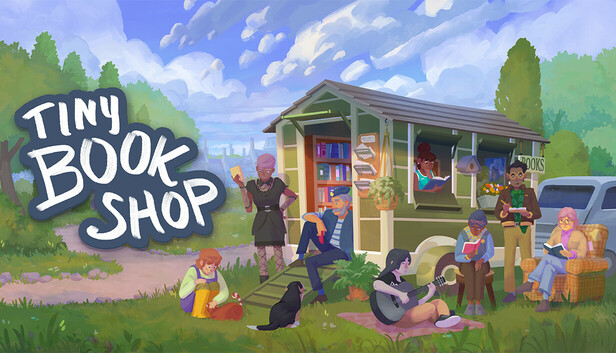
Tiny Bookshop offers a very particular escape: leave the old life behind, tow a small second-hand bookshop to the seaside and become the person who knows exactly which paperback somebody needs. It is a considerably more appealing retail fantasy than finding a mystery spill in aisle four. Developed by neoludic games, this single-player narrative management game launched in full on August 7, 2025 [1], beginning a new life in Bookstonbury-by-the-Sea.
The interesting part is not simply that the setting is pleasant. Selling books gives the conversations a purpose, and meeting customers gives the stock a meaning beyond its resale value. A shelf is both a modest business decision and a selection of possible introductions. That makes for a warm, inviting routine, although anyone hoping to become a ruthless bookselling tycoon should recalibrate. The game is much more interested in helping somebody find their next favourite read than in rewarding a terrifyingly efficient regional distribution strategy.
Reasons to look closer
The hook is the connection between a small shop and a growing sense of belonging. Locations attract different readers, decorations influence the business and recommendations help people find suitable books [1]. Those elements give an otherwise gentle routine enough decisions to feel personal. You do not need a literature degree, but an interest in books adds a lovely extra layer of recognition. There are few gaming pleasures quite as harmlessly smug as recognising a title and deciding that, yes, this fictional customer urgently needs to hear about it.
Opening up is a ritual, not an endurance test
Choosing where to park and what kinds of books to bring establishes the day’s possibilities. Once open, much of the selling happens around you, with customers occasionally requesting personal help. Nintendo Life praises that undemanding rhythm while also wishing for more direct involvement [3]. Both reactions describe the same design. The game wants the pleasure of watching a little enterprise work without requiring you to perform every transaction like a cashier whose supervisor has just discovered productivity charts.
That is inviting when you want a calm routine, but it can feel passive if you prefer constant decisions. Stocking, watching, advising and reinvesting are the heartbeat rather than a tutorial before a more punishing simulation begins. The useful question is whether a familiar daily pattern feels comforting or repetitive to you. Tiny Bookshop is not embarrassed about its modest scale, and it is better approached on those terms. A peaceful morning is allowed to remain a peaceful morning instead of unlocking a warehouse crisis.
The right book is not always on your shelf
Recommendations are where the books become more than colour-coded stock. A customer’s preferences ask you to connect a description with an actual title, turning a small sale into a moment of understanding. So Many Games found this delightful but noted that specific requests can outstrip both the available stock and the usefulness of the short descriptions [4]. Knowing literature helps, but even an excellent bookseller cannot recommend a book that failed to come along in the trailer.
That limitation gives inventory variety a purpose, while also creating the occasional slightly awkward guessing game. A request that sounds obvious may still be difficult to match from that day’s selection. The sensible response is to enjoy the act of matching rather than demand a flawless record. There is something nicely human about being unable to help everyone immediately. It also prevents the literary references from becoming only a recognition checklist: the important part is what a person wants, not how confidently you can announce that you have heard of an author.
A decorative skull is also a business decision
Decoration has a practical side beyond making the shop look inviting. PC Gamer’s feature describes using item bonuses to shift particular genres [6], while larger objects can increase rent and local tastes can reward a suitable theme. That creates a gentle tension between the shop you want to build and the stock you need to sell. A charming trinket can be a tiny merchandising strategy. The skull is not necessarily an alarming personal statement; sometimes it is simply helping the crime section.
This is a better fit for the premise than a huge, detached upgrade tree would be. The visible space and its business effects are connected, so rearranging things can express taste and solve a practical problem simultaneously. The trade-off is that purely aesthetic choices are not entirely free of consequences. If you are determined to decorate without thinking about sales, some bonuses will matter less to you. The systems are gentle enough to encourage experimentation, but there is still satisfaction in noticing why one arrangement serves a particular outing better than another.
The customers gradually become the reason to return
Bookstonbury’s recurring faces keep the shop from feeling like a vending machine with curtains. Their requests and small stories provide reasons to visit different locations and pay attention to more than the day’s takings. Pocket Gamer’s review found the community story compelling even when the daily routine became systematic [5]. That distinction helps explain Tiny Bookshop’s appeal: not constant mechanical reinvention, but more context for the people passing through a familiar process.
There are also small discoveries beyond the shelves, with clickable details, collectible objects and a journal helping the town feel like somewhere to notice rather than merely select from a menu. The appeal is deliberately low-key. These are not strangers arriving every morning with a prophecy about your destiny; sometimes they just need a book and a little consideration. If that sounds slight, the town may not provide enough momentum. If it sounds like a refreshing change from saving entire kingdoms, the scale is doing exactly what it should.
A cosy recommendation with a little retail attached
Tiny Bookshop is strongest when a practical decision and a personal interaction meet: bringing a useful selection, understanding a request, or making the trailer feel like a place its customers recognise. It is less compelling as a test of optimisation or a source of constant surprises. The developer describes it as an ambient narrative management game [7], which is a useful guide to its priorities. Management gives the day a shape; the narrative and atmosphere supply most of the reason to care about that shape.
The recommendation is straightforward for players who enjoy gentle routines, decorating and stories built around ordinary kindness. Anyone seeking a deep retail economy should be more cautious, especially if repeating a daily process quickly becomes tiresome. The current official availability list includes PC, consoles and mobile [2]; on mobile, a free opening portion leads to a one-time full-game unlock [8], rather than the entire game being free. Choose it for a pleasant place to become useful, one reader at a time. Your own unread books may consider the whole arrangement a betrayal.
Sources
Source links correspond to the numbered references in this review.
[1] Steam: Tiny Bookshop official release, credits, features and description • [2] neoludic games: Tiny Bookshop current released-platform links • [3] Nintendo Life: Tiny Bookshop review — Ollie Reynolds • [4] So Many Games: Tiny Bookshop review — Christopher Lannoo • [5] Pocket Gamer: Tiny Bookshop review — Jupiter Hadley • [6] PC Gamer: Tiny Bookshop feature — Andrea Shearon • [7] Tiny Bookshop official site: narrative management description and current availability • [8] Google Play: Tiny Bookshop official mobile trial and full-game unlock details