Quick Review
The Séance of Blake Manor gives detective work structure through guest schedules, organised evidence and an action-based clock that charges for investigating rather than thinking. Irish folklore and a suspicious household make following relationships and contradictions compelling. Deductions remain gated by collected clues, so being ahead of the investigator can feel restrictive, and the measured pace demands patience. Choose it for an atmospheric social mystery, rather than unrestricted theory-building or rapid-fire scares.
In this review
Introduction • Reasons to look closer • The clock charges for curiosity, not hesitation • A useful notebook cannot make the guests truthful • Make a case before making a scene • The folklore belongs in the evidence folder • Check in for the people, not a spotless itinerary • Sources
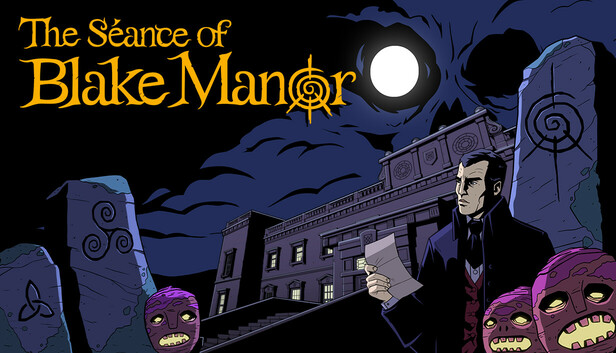
Blake Manor is hosting a gathering of mystics, which sounds like a difficult hotel booking before anybody goes missing. In Spooky Doorway's 2025 detective adventure [1], investigator Declan Ward arrives in western Ireland to find Evelyn Deane. The guests are preparing for a grand séance, the staff are unhelpfully calm, and normal professional boundaries are about to lose an argument with a locked drawer.
The attraction is the overlap between a proper missing-person investigation and a place steeped in supernatural beliefs. You have people to question, rooms to search and schedules to understand, all while deciding which oddity deserves your next few minutes. This suits the player who enjoys building a case out of small observations. Someone hoping to follow a single glowing trail to the villain will have a less comfortable weekend. So, presumably, will the hotel's insurer.
Reasons to look closer
A strong setting, a busy cast and an action-based clock give the investigation a useful sense of purpose. The journal helps organise discoveries without requiring a filing cabinet beside your keyboard. Irish folklore supplies more than decorative cobwebs: understanding the beliefs surrounding the gathering is part of understanding its people. The appeal is patient, attentive detective work with an uneasy atmosphere, rather than combat or a procession of loud surprises. Bring curiosity, and perhaps slightly less respect for other people's cupboards.
The clock charges for curiosity, not hesitation
The most important distinction is that time advances through investigation, rather than simply because you stopped to think. GamesRadar's review explains the minute-by-minute action cost [3]: examining something new or asking another question spends a little of the available day. You can consider your next move without treating a trip to the kettle as negligence. But investigating everything indiscriminately has a price. A ticking-clock description should not leave you thinking that pausing to consider evidence spends the day like asking another question does.
That gives ordinary detective decisions some weight. Do you pursue the promising lead, inspect another room or catch someone before their schedule changes? The interest comes from choosing a direction with incomplete knowledge. It can also create more anxiety than the actual pressure warrants, particularly if your usual adventure-game routine is to exhaust every dialogue option in alphabetical order. Give that habit the evening off. The clock is a reason to prioritise, and prioritising is more interesting than clicking every object because it has politely agreed to be clickable.
A useful notebook cannot make the guests truthful
The supporting interface matters enormously in a story with so many moving people. PC Gamer praises the maps, research desk and timetable [2] for organising what the player has actually discovered. A record of someone's plans is useful; a record of what they claimed their plans were is useful in a different, potentially incriminating way. Convenient presentation doesn't make the witness reliable.
This is a good compromise between supplying answers and demanding that you photograph every scrap of evidence yourself. It leaves room to concentrate on relationships and contradictions rather than remembering which menu contains the important name. The limitation is equally worth recognising: a tidy evidence system is still a designed path through a written mystery. Enjoy the process of following and testing leads, rather than expecting a completely unrestricted detective sandbox. You are untangling a carefully authored household, not receiving a police badge and permission to accuse the wallpaper.
Make a case before making a scene
Conclusions arrive through hypotheses assembled from collected information. Adventure Game Hotspot describes the word-bank deductions [4], followed by confrontations and actions that advance a character's mystery. That structure makes the final connection legible: the game asks you to express an explanation rather than merely owning the correct assortment of suspicious objects.
There is a trade-off in how that explanation becomes available. Players who like a clear invitation to bring their evidence together can appreciate the structure; those who want to submit a wild theory whenever inspiration strikes may find the gates too visible. The pleasure is in making sense of this particular story, with some help keeping its parts in order. A solution that seems obvious to you can still need the supporting discoveries. Consider whether you enjoy that confirmation stage. Being mentally ahead of a detective is flattering until you are waiting for him to finish the paperwork.
The folklore belongs in the evidence folder
The official description [5] places Irish mythology and Victorian spiritualism at the centre of the gathering. That is a more interesting foundation than using a haunting as permission for anything to happen. Different beliefs give characters reasons to interpret the same occurrence differently, and the possibility of something genuinely supernatural doesn't remove the need to ask who benefits from a particular explanation.
The comic-book presentation is well matched to that uncertainty. Strong shapes and theatrical imagery can suggest something troubling without filling every corridor with spectacle. The best reason to choose this setting is an appetite for its people and ideas, not merely a desire to be startled. It remains dark material, with violence, murder and substance-abuse references flagged by the developer. Someone attracted by the illustrated style should not mistake it for a cosy hotel mystery. The towels may be folded; the emotional baggage very much is not.
Check in for the people, not a spotless itinerary
Blake Manor's strongest invitation is to spend time inside a detailed social mystery and notice how its pieces fit. The PC release also has a demo, a sensible way to test your tolerance for its pace and time system. The September 2026 update [6] brought the demo into line with the full game and added practical refinements, including dialogue-skipping options and clearer alignment between journal categories. Those are helpful improvements in an adventure where reading and revisiting information are major activities.
The recommendation comes with a patient-reader proviso. Prefer this if learning about a suspect is a reward in itself and you enjoy arranging a day around promising conversations. Give it more thought if you mainly want difficult, open-ended logic puzzles or rapid scene changes. The mystery's appeal rests on attention to the people inhabiting it. Come for a missing woman and an alarming séance; stay because even the apparently ordinary guests seem to require a follow-up question.
Sources
Source links correspond to the numbered references in this review.
[1] Steam — release date, developer, publisher, single-player mode, Windows/Linux requirements and demo • [2] PC Gamer — review by Kerry Brunskill, 4 November 2025 • [3] GamesRadar+ — review and action-based time system • [4] Adventure Game Hotspot — review and hypothesis/confrontation structure • [5] Official game website — setting, investigation and art direction • [6] Official Steam announcements — September 2026 demo/full-game patch and console announcement • [7] PlayStation Store — PS5 edition and current release status • [8] Xbox Store — Series X|S edition and current release status • [9] Nintendo — Switch 2 release date, 27 October 2026