Quick Review
The Roottrees Are Dead makes researching a wealthy family's scattered records into a satisfying deduction game. Connecting names, photographs and occupations rewards attention, while useful notes and optional hints reduce clerical friction without taking the reasoning away. Expect reading, revisiting evidence and occasional dead ends rather than dramatic interrogations or intimate relationships with every relative. It is an excellent fit for players who enjoy proving connections themselves and finding the important detail in apparently ordinary information.
In this review
Introduction • Reasons to look closer • Everybody has a name, which is less helpful than it sounds • The notebook should get a share of the inheritance • When in doubt, consult the qualified rubber duck • A remake with more than a freshly dusted computer • Choose an evening for following the evidence • Sources
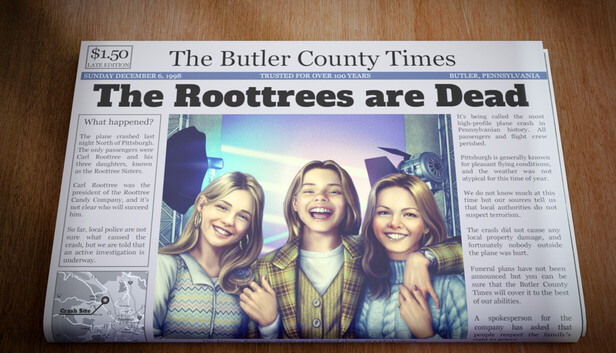
Somewhere in this mountain of family paperwork is a very wealthy person you have not identified yet. The Roottrees Are Dead gives you a computer, a sprawling genealogy problem and the creeping suspicion that an apparently irrelevant magazine article is about to become your entire evening. A plane crash has killed the most prominent members of a candy-company dynasty, and an unusual inheritance arrangement makes the surviving blood relatives suddenly important. Conveniently, none of them has submitted a neatly labelled folder.
This is the commercial remake released on 15 January 2025 [1], rather than the earlier free browser game. Its appeal is wonderfully specific: patient reading, connections between scattered clues, and the pleasure of proving something yourself. If your favourite part of a detective story is assembling the explanation, there is plenty to chew on here. Bring curiosity. The family has brought complications. Even a persuasive solution laid out in video game reviews cannot replace the pleasure of proving those connections yourself.
Reasons to look closer
The mystery gives ordinary information unusual weight. A photograph, an occupation or a throwaway reference can alter your understanding of an entire branch of the family. Useful note-taking tools keep the research manageable, while optional hints mean a stubborn blank need not end the evening. The expanded release also includes Roottreemania, another substantial mystery. The attraction is the deduction itself: finding a connection because you noticed it, rather than because a protagonist thoughtfully announced it while you were looking elsewhere.
Everybody has a name, which is less helpful than it sounds
Filling the tree requires more than collecting surnames. You must connect people to photographs and occupations, working through web searches, publications and other evidence. GameSpew describes the hunt for less prominent relatives [4] as the point where straightforward searches give way to following indirect leads. Fame makes a person easier to find; an obscure cousin is considerably less considerate about maintaining an online presence.
That structure gives the puzzle a welcome sense of ownership. You decide which loose thread deserves attention and whether a new detail fits something already discovered. It also demands tolerance for apparent dead ends. Someone hoping to interrogate colourful suspects in quick succession may find this rather desk-bound. The drama lives in understanding a record differently, sometimes after several unproductive searches. A tiny biographical detail can be a breakthrough, but the game expects you to care enough to spot it.
Return of the Obra Dinn review — another identity-deduction mystery, swapping family records for frozen scenes aboard a ship.The notebook should get a share of the inheritance
There is a practical difference between being challenged to think and being challenged to remember which window contained the useful sentence. PC Gamer highlights the ability to select text and send it to a search or notebook [3], reducing the clerical shuffling between discoveries. That is an important kindness in a game whose central activity involves moving information around. Your detective career should not require a second career as a transcription service. Distinguish the difficulty of drawing connections from the clerical effort of moving clues between windows.
Good tools still leave the interesting decisions with you. Which name matters? Is this a genuine connection or merely two people sharing a profession? Keeping useful notes is part of learning the case, rather than a separate chore attached to it. The large cast can nevertheless feel more like a web of evidence than a company of intimate acquaintances; PC Gamer also found the emotional connection uneven. Readers who need every character to become a vivid companion should set expectations accordingly.
When in doubt, consult the qualified rubber duck
The rubber-duck hint system [5] offers progressively stronger help, eventually supplying an answer if you keep asking. That is a sensible fit for a puzzle with many moving pieces: getting stuck need not mean abandoning the whole family. There is no need to spend another hour glaring at a portrait out of misplaced professional pride. The duck has seen worse.
Use that safety net deliberately, though. A nudge toward a neglected branch preserves more of the pleasure than having the remaining blanks explained immediately. The game also confirms correct entries in groups rather than rewarding every individual guess, so an unconfirmed theory is not automatically a wrong one. This makes certainty something you build. It can also make a slightly incorrect detail surprisingly awkward to locate among otherwise sound deductions. Dates, relationships and the precise information requested deserve a second look before accusing the software of a conspiracy.
A remake with more than a freshly dusted computer
The original creator distinguishes the Steam remake [6] from the free 2023 version through new illustrations, voice acting, improved puzzles, interface work and an expanded story. That matters if you have heard the title recommended for years and are wondering why it belongs in a 2025 conversation. The earlier browser release is the ancestor, not a second platform edition of this exact package.
The new presentation gives the investigation a more considered setting, but the crucial addition is further work for the detective. Roottreemania provides a new tree after the original case, revisiting the family from another angle. Familiarity can be useful without eliminating the puzzle. Existing fans have a stronger reason to return than a cosmetic replacement of things they already know; newcomers get room to put their developing habits to work. Naturally, the reward for untangling a wealthy family is discovering that it contains more tangled family.
Choose an evening for following the evidence
David.reviews emphasises the open-ended investigation [7] and the challenge of deciding what deserves a note. That is the useful buying test. Do you enjoy returning to information with a better question, or does rereading feel like the game has failed to entertain you? Roottrees makes the strongest case for the first group. Its quiet setting leaves room for your own reasoning, and the occasional humour prevents the paperwork from acquiring the full personality of an insurance claim.
The 2025 edition is available on Windows, macOS and Linux. The developer announced iOS and Android versions with touch controls for November 5, 2026. As of this November 1 check, that remains a scheduled mobile release, not an already available option. Wherever you eventually investigate, resist treating the family tree as a checklist to rush through. The names are the answers, but noticing why they belong together is the enjoyable part. The fortune can wait while you check one more article.
Sources
Source links correspond to the numbered references in this review.
[1] Steam — 2025 release, developer, publisher, modes and desktop platforms • [2] Evil Trout — official game site and mobile availability • [3] PC Gamer — Tom Sykes review, interface and character discussion • [4] GameSpew — Kim Snaith review, investigation and evidence • [5] Siliconera — Stephanie Liu review, hints and confirmation system • [6] Jeremy Johnston — original browser release and remake differences • [7] David.reviews — deduction structure and RoottreemaniaThe Roottrees are Dead: mobile release planned for November 5