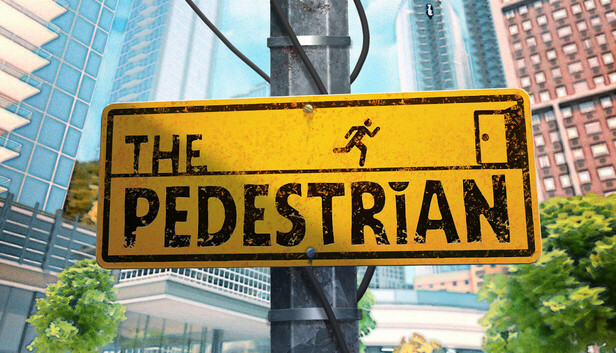
Quick Review
The Pedestrian turns signs into connected puzzle rooms, asking you to arrange doors and ladders before guiding a tiny figure through your plan. The clever relationship between flat panels and the surrounding city makes progress feel wonderfully tangible. Broken connections can reset your work, and uneven difficulty without dedicated hints may stall the charm. Patient puzzle fans who enjoy planning several moves ahead will get more from it than players seeking a story-led stroll.
The Pedestrian is an easy recommendation for puzzle fans who enjoy taking an ordinary object apart in their heads. Skookum Arts turns public signs into little rooms, then lets you rearrange the connections between them. The hook is immediately charming, but the real attraction is the planning underneath. Come for the tiny person escaping their day job as signage; stay for the increasingly elaborate route-building. Just bring patience for experiments that unravel and a willingness to enjoy a journey with very little conversation.
That premise deserves a moment. Most games see an exit sign as something to hang above a door. This one sees a protagonist, a stage and a surprisingly complicated transport network. Your character runs and jumps inside flat panels mounted throughout a three-dimensional city. Switching into the arrangement view lets you move panels and connect their entrances. A door is only useful when you have given it somewhere sensible to go. Finally, a game about the importance of a competent facilities department.
A small figure in a much bigger world
The strongest creative decision is keeping those flat puzzle spaces attached to a recognisable world. Signs, boards and screens become places rather than an abstract selection of boxes. The city around them gives each solved route a destination. There is something wonderfully disproportionate about a person made from a few simple shapes gaining influence over machinery outside their own panel. The contrast makes the central idea expressive without needing a cast of chatty companions.
PC Gamer's review highlights how the surrounding environment helps communicate progress, including electrical connections that affect real-world equipment. That is the distinction that makes The Pedestrian worth noticing among puzzle-platformers. Solving a diagram and travelling somewhere become parts of the same thought. The setting is doing design work as well as looking attractive. If you like games that reward looking at the edges of the screen, rather than following a speech bubble to the next objective, this is inviting territory.
Good routes need a little forward planning
At the centre of the game is a satisfying division of labour: arrange the route, then send your small traveller through it. Doors and ladders make connections between signs, while objects inside those signs create reasons to reconsider the whole arrangement. Keys, crates, switches and moving platforms add practical questions to the diagram. Where does this object need to end up? Can the character still reach the exit after moving it? A tidy-looking plan is no guarantee of a usable one.
The important catch is that connections have consequences. As LadiesGamers explains in its Switch review, breaking a connection after the character has travelled between signs resets puzzle progress. That rule turns casual rearranging into a commitment. You cannot assume that every promising shortcut is free. For players who enjoy reasoning several steps ahead, that is the appeal: the answer needs to survive being used, not merely look clever from above.
It also explains the main caveat. A calm presentation does not promise a frictionless puzzle game. Reworking a large arrangement can be fiddly, and LadiesGamers notes both uneven difficulty and the absence of a dedicated hint system. Expect to stop and reconsider rather than receive a friendly nudge whenever momentum stalls. Take a break if a solution becomes a blur of lines and stubborn certainty. The sign person can wait. They have spent most of their career standing still.
Which version, and what should you expect?
The Pedestrian is a single-player game developed and published by Skookum Arts. Its original desktop release was January 29, 2020, and Steam lists Windows, macOS and Linux versions. PlayStation 4 and PlayStation 5 versions followed on January 29, 2021; the PlayStation listing includes both. Xbox One and Xbox Series X|S arrived in January 2022. These are released versions, not a list of hopeful port announcements.
Nintendo Switch joined them on January 18, 2024. Nintendo also lists the Switch game as supported on Switch 2 through compatibility. That should not be mistaken for a separate native Switch 2 edition. The Switch listing supports TV, tabletop and handheld play. Steam lists a demo, making a trial a sensible first stop if you are unsure whether rearranging signs sounds delightful or suspiciously like organising office stationery.
Choose primarily around where you like solving puzzles, rather than assuming every release has identical controls or performance. A textless adventure reduces the need to read dialogue, but interpreting visual relationships is still the main activity. Likewise, a single-player designation does not stop someone on the sofa offering suggestions, although the official mode is one player. Expect shared theories if you invite company, not a built-in co-op campaign or a second controllable pedestrian.
Worth following the signs
The Pedestrian makes its best case to people who value a focused idea developed thoughtfully. Its visual premise provides the invitation; arranging a functioning route supplies the substance. The limited storytelling will be a drawback if you need characters and revelations to pull you forward. PC Gamer also found that narrative restraint less satisfying than the puzzle progression. Treat the journey itself as the main attraction, and the priorities make much more sense.
Our recommendation is to try the demo, then commit if the first few connections make you curious about the next complication. Puzzle enthusiasts should find a distinctive premise worth their attention, while players who dislike resetting plans should approach more cautiously. This is a game for looking, testing and occasionally admitting the ladder belonged somewhere else. For a public-safety icon, that little pedestrian has an excellent understanding of how to lead people into trouble.
Sources
Official information and review sources supporting this article.
Steam · PlayStation · Xbox Wire · Nintendo · PC Gamer review · LadiesGamers review