Quick Review
The Midnight Walk takes you through a tactile, handmade nightmare with a small flame-bearing companion worth protecting. Closing your eyes to listen and using light around threats give its striking art and melancholy music a fitting interactive role. The route is tightly guided and puzzles are modest, so mechanical depth is not the main reward. Players drawn to atmospheric fairy tales should enjoy its tenderness and menace more than those seeking intricate survival systems.
In this review
Reasons to look closer · The crooked scenery is the main event · Closing your eyes is unexpectedly useful · Fire solves problems and attracts new ones · The soundtrack remembers there is a heart in here · Worth the walk, if you want the story more than the puzzle box · Sources
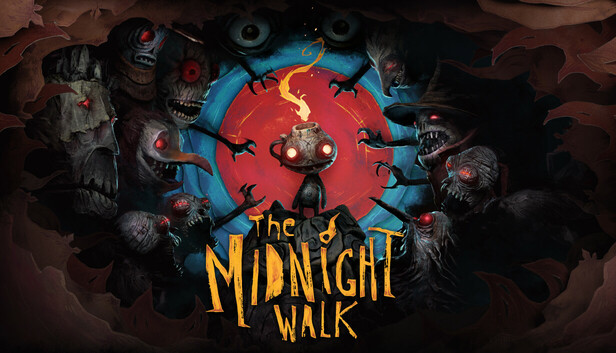
The Midnight Walk gives you a small companion with a flame on his head, then fills the surrounding countryside with creatures that would like to eat it. Potboy is both your friend and an inconveniently visible snack. MoonHood’s dark fantasy adventure reached its full release on May 8, 2025 [1], sending the Burnt One through a handmade world where warmth is precious and most silhouettes deserve a second opinion.
This is an invitation to inhabit a peculiar fairy tale rather than master a vast collection of systems. The attraction lies in the uneasy combination of tenderness and menace: protecting something endearing while the landscape quietly auditions for your next nightmare. Simple interactions keep the journey approachable, but they also limit how much satisfaction comes from solving its problems. If a striking world can carry an evening for you, there is plenty of reason to set off. If you need intricate mechanics to justify every step, pack some caution alongside the matches.
Reasons to look closer
The key promise is a dark place that still has something worth caring about. Potboy brings purpose to the journey, while fire offers both assistance and unwanted attention. VR is optional, not an entry requirement [1], so the unusual presentation is not restricted to headset owners. The experience is deliberately directed and story-focused; it makes more sense as an atmospheric adventure than a demanding horror survival test. Expect curiosity, affection and occasional alarm to do more of the work than inventory arithmetic or elaborate combat builds.
The crooked scenery is the main event
The tactile appearance comes from physical models scanned into the game, with animation that preserves a stop-motion character. Nintendo Life’s review praises the resulting sense of a world that moves and reacts around you [6]. That matters beyond the novelty of knowing somebody actually made these things. Uneven surfaces and oddly proportioned creatures give the setting a coherent personality, as though a dusty storybook has climbed off the shelf and developed several deeply questionable habits.
It is not simply a procession of threatening statues, either. Housy, a travelling home on legs, turns a familiar promise of shelter into something visually unnerving. Potboy supplies a different kind of contradiction: a creature who belongs in this strange landscape but makes it feel less lonely. Those contrasts are more effective than relentless ugliness would be. When everything is equally horrible, horror can become wallpaper. A little companionship gives the shadows something to threaten, and gives the player a reason to notice the difference between strange and hostile.
Closing your eyes is unexpectedly useful
The signature action is shutting the Burnt One’s eyes. PlayStation’s developer walkthrough explains how this heightens important sounds and can change parts of the environment [2]. On a normal screen, that uses a button; PS VR2 can use your actual eyelids. It is a neat reversal of the usual instruction to keep looking for danger. Here, deliberately surrendering sight can be how you understand what is around you. Finally, an adventure with a practical application for refusing to look at the problem.
The appeal is sensory rather than fiercely cerebral. Listening changes how a space is read, while the vulnerability of closing your eyes gives a simple interaction dramatic weight. It also suits the broader relationship between darkness and light instead of feeling like a disconnected puzzle toy. For players who need help interpreting those cues, UploadVR notes an optional visual aid for locating objects during these moments [3]. The idea works best as another way of paying attention, not as a promise that every encounter hides an endlessly flexible perception puzzle.
Fire solves problems and attracts new ones
Lighting the way is not a straightforward victory when the monsters are interested in the light. Potboy’s flame and your own tools help manipulate obstacles and distract threats, making progress a matter of directing attention rather than overpowering everything nearby. UploadVR found the stealth sequences nerve-racking while describing the puzzles as relatively undemanding [3]. That is a useful distinction: a creature can be frightening without requiring a technically complicated solution. The cupboard is sometimes a perfectly respectable tactical headquarters.
The limitation is how little room there is to invent a radically different approach. The adventure supplies situations to work through, not a survival sandbox in which you improvise a whole alternative lifestyle. That can be welcome when the goal is to preserve a story’s pace, but it makes expectations important. Do not arrive looking for elaborate combat, resource economies or a large collection of interlocking abilities. The challenge is usually recognising what the scene wants and doing it while a very unpleasant presence encourages you to hurry.
The soundtrack remembers there is a heart in here
An attractive nightmare needs more than good monsters if it wants the journey to matter. Game Informer singles out the music for communicating feeling when the central characters do not speak [4], and for giving acts of rekindling light emotional significance. That is a stronger use of a score than simply placing ominous noises behind ominous scenery. Warmth becomes something the presentation can express, not merely an objective the narrator has asked you to complete.
The story’s melancholy also makes its small moments of affection important. A grim world can become exhausting when its only message is that the next place will be worse; companionship offers another reason to continue. The same review found the mechanics less remarkable than the art and music, which is the essential trade-off rather than a minor footnote. The distinction matters when comparing video game reviews: you are accepting modest interaction in exchange for an unusually cohesive mood. Whether that feels absorbing or thin depends on how much pleasure you take in inhabiting a carefully arranged scene.
Worth the walk, if you want the story more than the puzzle box
The sharpest reservation is the narrowness of the route. Slant argues that frequent guidance and tightly prescribed interactions constrain the game’s most interesting ideas [5]. That criticism makes sense for anyone hoping the eye-closing mechanic will grow into a deep tool for experimentation. A memorable action can remain memorable without becoming a demanding system, but those are different achievements. Beautiful scenery does not automatically make an obvious solution less obvious, even if the tree beside it appears to be judging you.
The Midnight Walk is easiest to recommend to players drawn to tactile art, melancholy fantasy and a companion worth ushering through danger. Players seeking intricate puzzle systems should be more cautious: puzzle complexity and sustained mechanical challenge are weaker reasons to buy. The native Switch 2 version joined the original releases in March 2026 [7], widening access to the same peculiar journey. Choose it for the atmosphere and the emotional contrast between fragile light and overwhelming dark. Just avoid assuming that a charming little flame turns the surrounding horror into a relaxing countryside ramble. The countryside has other plans.
Sources
Source links correspond to the numbered references in this review.
[1] Steam: The Midnight Walk official release, credits, single-player and optional VR details • [2] PlayStation Blog: Developer walkthrough of The Midnight Walk and its eye-closing mechanics • [3] UploadVR: The Midnight Walk review — Henry Stockdale • [4] Game Informer: The Midnight Walk review — Charles Harte • [5] Slant: The Midnight Walk review — Eli Friedberg • [6] Nintendo Life: The Midnight Walk Switch 2 review — Ken Talbot • [7] Nintendo: The Midnight Walk native Switch 2 listing and March 26, 2026 release