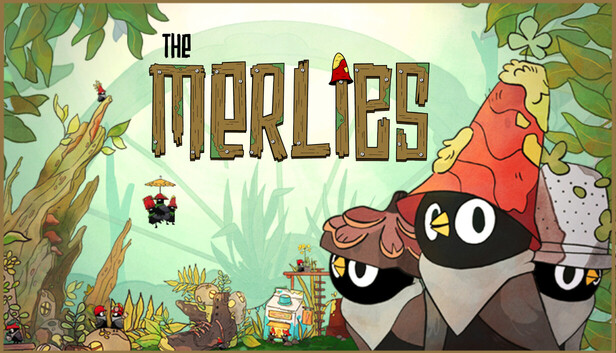
Quick Review
The Merlies builds a gentle exploration adventure around tiny birds rescuing neighbours and furnishing a village from humanity's leftovers. New abilities gradually open the oversized world, making discarded objects useful landmarks and the community a reason to keep looking. A guided opening limits immediate wandering, while natural hazards mean the absence of fighting is no guarantee of safety. It suits players who prefer characterful discovery and rebuilding to combat, with a weakness for creatively repurposed rubbish.
The Merlies puts the apocalypse in perspective: humanity has disappeared, but an ice cube tray can still make an excellent storeroom. Released on September 29, 2026, this exploration adventure follows tiny birds rebuilding their scattered community. Their different abilities open routes through an oversized world, while recovered scraps furnish a new village. There are no fights, but natural hazards remain. Cute does not mean indestructible; somebody still needs to watch the thorns.
Finding routes through a discarded world
The developers' explanation of the map is more interesting than a simple promise of cozy wandering. In their October community Q&A, they describe pollution increasing as you travel farther, with large discarded objects serving as landmarks. That makes the rubbish do two jobs: it tells the story of a damaged world and helps you remember where you are. A memorable heap of human failure is, at least, a useful navigation aid. The approach suits an adventure about small creatures trying to understand an environment that was never built for them.
Accessibility also shapes the route through it. The team says the opening is more linear, then movement abilities gradually broaden exploration. That is a sensible compromise between giving newcomers direction and allowing the map to become something they can investigate. It may be less immediately appealing to players who want to get gloriously lost from the first minute. The stated intention is a guided beginning that grows outward, not a vast maze dumped onto your doorstep with a cheerful instruction to sort yourself out. New abilities should have somewhere meaningful to take you within that design.
Recruitment makes the village personal
Writer Florence Rivières's published recruitment examples offer a particularly good window into the characters. These are May 8 prerelease samples, not a guarantee that every line or task survives unchanged in the finished game. Sprouter refuses to leave the desert without a struggling flower; helping the bird means helping what the bird cares about. Inventor, meanwhile, turns pieces of a discarded credit card into a sturdier glider. That is a much better use for plastic than buying another thing to throw away. Each encounter connects a personality to something the player needs to do.
Then there is Bard, trapped in a toaster and apparently determined to make the situation everybody's theatrical problem. The example moves from rescue to a request for a place to perform back home. That connection matters: bringing somebody into the community should give them a life there, not merely tick another name off a collection list. These written scenarios make the rebuilding premise feel personal. A village is more interesting when its residents want different things, including the occasional captive poet with strong opinions about breakfast equipment.
World loading and progression repairs
There is a practical boundary behind that sprawling world. In a September interview, Blue Ramen developer Denis Maillot explains that only the player's current environment is loaded, with the next area brought in as they cross its boundary. That describes how the world is assembled, not how smoothly any particular machine runs it. He also describes testing routes through every area and activity, checking results and finding unexpected bugs. For an exploration game, that emphasis is relevant: reaching somewhere is only half the job if the activity waiting there cannot finish. It is encouraging to see those interactions treated as something to verify systematically. It is not a warranty. A testing checklist and an uneventful afternoon of play are, regrettably, two different products.
The early updates make that distinction worth keeping in mind. The October 5 patch reports village softlocks, missing or unrecruitable birds, objects remaining visible after collection and other progression or presentation problems. In a game built around bringing a community together, being unable to recruit somebody is more than an untidy edge. It interrupts the point of the journey. The same update addresses cooking feedback and a heart indicator, details that help players understand what the game has registered. These are useful, specific repairs, but the notes cannot establish that all related problems are gone. The cautious recommendation is therefore to approach The Merlies for its gentle premise rather than assume gentleness guarantees reliability. Players particularly sensitive to blocked progress may prefer to check the latest maintenance state alongside the build dates in PC game reviews before committing to a long visit. Even the nicest bird village should have a functioning arrivals desk.
SteamLaunchDesignWritingInterviewUpdate1Update2