Quick Review
The Drifter gives point-and-click deduction the urgency of a grim thriller, with practical inventory puzzles and a protagonist whose repeated deaths raise more questions than reassurance. Clear clues, atmospheric pixel art and a humane cast make its dangerous situations compelling. Timed trial and error can interrupt that momentum, and the widening conspiracy is less satisfying than the opening mystery. It suits patient adventure fans after focused puzzles and adult pulp storytelling, rather than freeform improvisation.
In this review
Reasons to look closer · Practical problems, deeply impractical working conditions · Another death is information, not a holiday · A controller gets an actual plan · The grime is doing character work · A strong recommendation, with room for the conspiracy · Sources
Mick Carter returns to his hometown and promptly encounters a shooting, armed pursuers and a drowning. Then he comes back, moments before his death. This is an appalling travel itinerary, but a promising opening for a thriller. Powerhoof’s The Drifter [1] builds its point-and-click adventure around a man whose inability to stay dead creates more questions than reassurance. Its full release arrived on July 17, 2025, rather than through an Early Access chapter plan.
The attraction is a collision of practical problem-solving and increasingly impractical circumstances. You are still inspecting locations and working out what to do with an object, but the surrounding story would prefer that you did it before something terrible happens. That gives an old-fashioned adventure format unusual urgency. It also establishes the central trade-off: a thriller wants to keep moving, while a puzzle is perfectly entitled to leave you staring at a cupboard with a very serious expression.
Reasons to look closer
The Drifter is worth a closer look if you want an adventure that treats puzzles as part of a predicament rather than an audition for the world’s least employable inventor. Its practical inventory-based design [2] sits inside a conspicuously unpleasant mystery, with a strong sense of place and a protagonist who has reasons to be troubled beyond the immediate murder arrangements. For anyone seeking a more open-ended adventure, the important limit is that this is a directed story, not a sandbox of interchangeable solutions. The pleasure is understanding the escape route the game has built, then watching the next situation make that achievement feel distressingly temporary.
Practical problems, deeply impractical working conditions
The basic appeal is familiar: examine a scene, gather information and objects, then connect them in the right way. PC Gamer’s review praised the interface for supplying useful information [3] and limiting blind guesswork. That matters in a story built around danger. A clue that points towards an intelligible action supports the tension; a mystery interaction buried in an unremarkable pixel would mostly support a complaint to the furniture manufacturer.
This remains authored puzzle-solving, however. Understanding what ought to happen and discovering the exact sequence the game accepts are not always identical activities. The sensible expectation is a chain of small deductions, not an immersive simulation where every plausible workaround earns approval. That narrower design suits the thriller’s momentum, but players who primarily enjoy experimenting with systems may find its boundaries more noticeable than players who want the next revelation. There is a difference between escaping a room and being allowed to redesign it.
Another death is information, not a holiday
Mick’s returns make failure part of the premise, but they do not make danger cosy. Adventure Game Hotspot describes timed sequences that can involve trial and error [4], even while praising the generally logical puzzles. Learning what goes wrong can reveal what must change on the next attempt. The result is an adventure that can stage a lethal predicament without treating one wrong decision as the end of the entire evening.
The catch is repetition inside urgency. A scene can tell you that every second matters while you are still establishing which action belongs first. The same review highlights welcome housekeeping elsewhere: obsolete inventory items and irrelevant conversation topics are cleared away, reducing mental clutter. That is a useful counterbalance, not a guarantee against getting stuck. Expect quick thinking more than demanding reflexes, and recognise that a failed attempt can be a clue rather than evidence that your career as a fictional fugitive is over.
A controller gets an actual plan
The Drifter does more than attach a sluggish virtual mouse to a stick. Its controller scheme uses movement on one stick and a selection of nearby interaction points on the other. Slant found this approach effective in principle but less immediately clear during tense moments [5], preferring the mouse when rapid identification mattered. That is the relevant distinction: the interface offers a different way to select objects, not a magical exemption from learning where everything is.
The Nintendo releases also arrived with a useful extra option: Powerhoof confirms Switch 2 Joy-Con 2 mouse support [7], alongside controller input. Choice is especially welcome in a genre where the verbs are simple but selecting the right target is the whole job. None of this needs to dictate a platform purchase by itself. It does mean the adventure has considered the sofa rather than simply assuming every player is leaning over a desk, interrogating a drainpipe with a cursor.
The grime is doing character work
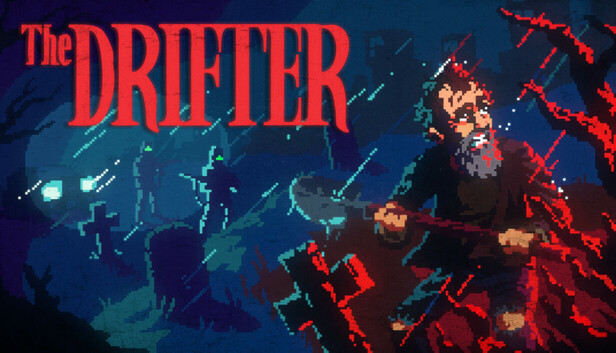
The pixel art is not merely a nostalgic wrapper. Shadowy urban spaces and expressive animation give the story a physical texture: this is a world that feels inhabited before the conspiracy arrives to make everything worse. A full voice cast and a dark-synth score, detailed in the official credits and press material [1], support the cinematic approach. The important achievement is cohesion. The visuals, voices and atmosphere are all applying for the same ominous job.
Hey Poor Player particularly praised the characters’ humanity [6], including the treatment of people living on the margins. That gives the ugliness somewhere meaningful to land. Without a recognisable person inside the predicament, a succession of shocks would become a very elaborate fireworks display with worse sanitation. Mick’s circumstances provide a reason to care about more than solving the immediate obstacle, and the supporting cast helps the setting feel like a damaged community rather than a cupboard full of plot devices.
A strong recommendation, with room for the conspiracy
The main reservation is where all that escalation leads. Hey Poor Player found the later answers less satisfying than the initial mysteries [6], with the story’s different halves not fitting together perfectly. That is worth weighing when comparing video game reviews of The Drifter, especially if its intimate, grounded opening is what sells you on the game. A widening conspiracy can add spectacle while weakening the particular emotional thread that made the first hour interesting. Bigger secrets are not automatically better secrets; sometimes they simply require a larger noticeboard.
The Drifter nevertheless makes a persuasive choice for players who enjoy focused adventure puzzles, adult pulp fiction and a story willing to make its protagonist’s day aggressively worse. Its clarity and presentation look more inviting than the genre’s reputation for bewildering item combinations suggests, but the linear solutions and occasional repeated danger still require patience. Choose it for the combination of deduction, atmosphere and forward motion. Skip it if your ideal mystery offers unlimited improvisation, or if repeated brushes with death sound less exciting than a quiet evening in a town with functioning public services.
Sources
Source links correspond to the numbered references in this review.
[1] Powerhoof: The Drifter official press kit, release dates, platforms and credits • [2] Steam: The Drifter official store page, developer, publisher and game details • [3] PC Gamer: The Drifter review — Shaun Prescott • [4] Adventure Game Hotspot: The Drifter review — Sam Amiotte-Beaulieu • [5] Slant: The Drifter review — Steven Scaife • [6] Hey Poor Player: The Drifter review — Andrew Thornton • [7] Powerhoof: The Drifter Switch and Switch 2 launch announcement, June 2026