Quick Review
The Berlin Apartment tells an intimate historical anthology through one flat and the people who occupied it. Packing, decorating and communicating give everyday objects emotional weight, while changing furnishings make a familiar space feel meaningfully different. Slow interactions, repeated gestures and uneven chapter development can interrupt the storytelling, and traditional puzzles are limited. It suits patient players drawn to domestic perspectives on difficult history, rather than broad exploration or a straightforward renovation game.
In this review
Reasons to look closer · The floor plan stays; the life inside it does not · An object can be more than something to pick up · Sometimes the hands-on part gets in its own way · The apartment looks different because it means something different · A worthwhile visit, with uneven rooms along the way · Sources
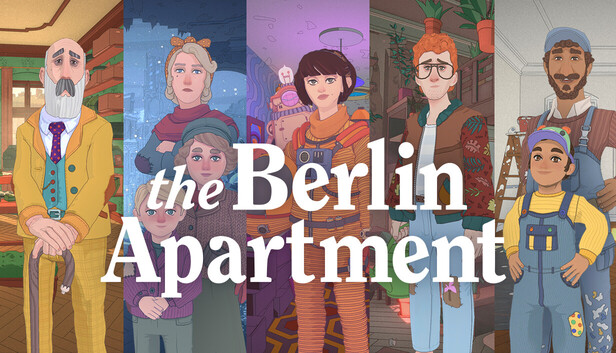
A renovation normally uncovers questionable wiring and somebody’s deeply personal opinion about wallpaper. The Berlin Apartment finds an anthology. Dilara joins her father Malik as he refurbishes a flat, and objects left behind open the door to stories about its former residents. Blue Backpack’s first-person adventure released on 17 November 2025 [1], turning a small domestic space into a way of approaching much larger historical events. That is considerably more than most contractors include in the original quote.
The 2020 framing story connects episodes set in 1933, 1945, 1967 and 1989 [2]. Rather than asking you to manage a city or change the course of history, the game puts you inside individual lives: packing possessions, trying to communicate, making a home or defending a piece of writing. Its colourful artwork is welcoming, but the material includes antisemitic persecution, war’s aftermath and political pressure. This is an intimate narrative adventure, not an uncomplicated afternoon of virtual decorating.
Reasons to look closer
The appeal is returning to a place whose meaning keeps changing. A familiar window or doorway can belong to a different emotional world when the occupant, furnishings and circumstances change. Small tasks give those differences something tangible to attach to, while the anthology format lets the game vary its mood without abandoning its central setting. If environmental storytelling is your favourite part of an adventure, this is unusually focused on it. The flat is doing more character work than several very large game maps.
The floor plan stays; the life inside it does not
The developer’s design overview emphasises furnishings, everyday objects and traces of previous residents [3] rather than traditional adventure-game puzzles. That is an important distinction. You are not primarily hunting the improbable object combination that will persuade a locked cupboard to cooperate. The room is interesting because it belongs to someone, and exploring it provides a route into their circumstances. Its physical limits help concentrate attention on details that might disappear inside a much larger playable city.
Reusing a location could have felt economical in the wrong sense, but here recognition is part of the idea. You can compare how people occupy the same space rather than constantly learning a new layout. The change of decor is not merely a fresh coat of historical paint; it gives familiar walls different associations. The limitation is equally clear: anyone who needs expansive exploration will find a deliberately narrow stage. The estate agent’s floor plan was technically accurate, just spectacularly incomplete about the contents.
An object can be more than something to pick up
The official chapter descriptions [2] make ordinary activities carry very different stakes. Josef prepares to leave Germany in 1933 as hostility against him grows. Kolja exchanges paper-plane messages across the Berlin Wall in 1989. A suitcase and a folded sheet of paper are modest objects, but the circumstances turn them into questions about what can be carried away and how contact can survive a barrier. That is a stronger premise than collecting historical trivia simply because it glows.
These stories work best approached as personal perspectives, not a comprehensive account of their eras. The apartment cannot represent every experience of Berlin, and the game’s dramatic scenes are not a substitute for historical context beyond them. Its advantage is scale: it can make you consider why a possession matters to one person before asking you to think about a much larger loss. The everyday action gives the subject a human point of entry without requiring a grand heroic role.
Sometimes the hands-on part gets in its own way
The game varies its interactions between stories, but variety is not automatically fluency. GameObserver criticises the slow handling of objects, repeated paper-plane construction gestures and frequent commentary on obvious details [4]. That is a meaningful objection in a game built around looking closely at belongings. If inspecting a room repeatedly produces explanations of what is already visible, curiosity can start feeling like an appointment with an unusually talkative cupboard. Attention should be rewarded with insight, not merely more words.
There is a genuine design tension underneath that complaint. Making a task physical can give it weight; making every stage of the task laborious can interrupt the scene it supports. The same goes for spoken reactions: a memory attached to an object can deepen a character, while a redundant observation can slow the search. Players who enjoy deliberate, conversational exploration may accept the pace more readily. Those who want brisk interactions should expect the storytelling to ask for patience rather than provide constant mechanical momentum.
The apartment looks different because it means something different
The comic-book presentation gives the rooms a distinct visual identity without relying on photorealism. Digitec highlights how colour contributes to the changing atmosphere [5], particularly when decorating brings warmth into a damaged home. That is a more useful role for visual style than simply making screenshots attractive. When the space reflects the resident’s situation, looking around becomes part of following the story. A bright palette does not erase the difficult material; it can make a small attempt at comfort more noticeable.
The same review particularly praises the German performances, while the official language listing confirms full English and German audio [1]. That gives players a meaningful presentation choice rather than one supposedly correct way to experience the story. Use the language that lets you follow both the dialogue and what your hands are doing comfortably. Subtitles can preserve a preferred performance, but they also compete for attention with objects and gestures. The room already contains enough things asking to be noticed.
A worthwhile visit, with uneven rooms along the way
An anthology does not need every chapter to feel identical, but it does need each to justify its space. IndieLoupe finds Josef’s episode especially effective while wanting more development from the shorter 1945 story [6]. That unevenness matters more than the premise alone when weighing an anthology. A powerful premise cannot guarantee that a brief visit provides enough time with its characters. The overall appeal is the accumulation of perspectives, rather than a promise that every individual episode will land with equal force.
The Berlin Apartment is a worthwhile choice for players drawn to domestic storytelling, historical settings and a place that changes without moving. For players seeking puzzles, the qualification is substantial: it is less convincing as a puzzle challenge or a frictionless sequence of interactions. The released PS5 [7] and Xbox Series X|S [8] versions sit alongside Windows, but the important choice is whether you want this deliberately contained kind of narrative. Give the residents your attention and the flat has plenty to offer. Just do not mistake the refurbishment work for the main attraction.
Sources
Source links correspond to the numbered references in this review.
[1] Steam — The Berlin Apartment official listing • [2] PARCO GAMES — official story, gameplay and specification page • [3] btf — The Berlin Apartment design overview • [4] GameObserver — The Berlin Apartment review • [5] Digitec — The Berlin Apartment review • [6] IndieLoupe — The Berlin Apartment review • [7] PlayStation Store — released PS5 version and publisher • [8] Xbox — released Xbox Series X|S version and publisher