Quick Review
Teeto gives its blob-and-bunny adventure playful transformations, useful scenery and a collection hunt that separates optional rescues from required progression. Swinging, blasting and smashing provide reasons to explore rather than simply vacuum up shiny things. Completion asks more than reaching the ending, and traversal clarity matters when sharing the journey in local co-op. It suits cheerful platformer fans who want an approachable outing with extra challenges available, plus an unusual number of creatures named Michael.
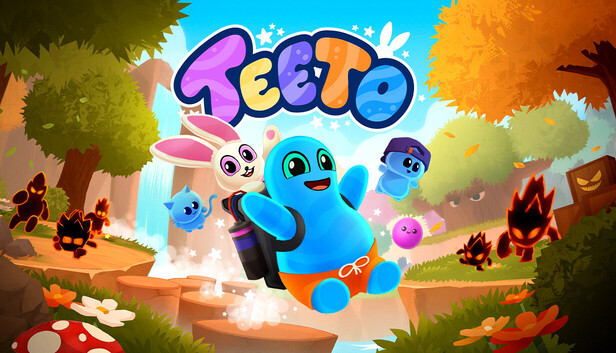
Released on July 15, 2026, Teeto pairs a blob and a bunny against shadow creatures. Sensible hiring practices were apparently unavailable.
Collecting on your own terms
The collecting has more structure than simply hoovering up anything shiny. In their Loot Level Chill interview, developers Mitch and Ali distinguish the optional Michaels from progression-gating Vionites and the stars that guide routes and buy costumes. Michaels are little creatures to rescue, not another compulsory currency. Giving the optional hunt a face is a smart invitation: finding a missing fellow feels different from completing an inventory. Calling every one of them Michael also gives the whole operation the air of an unusually colourful office evacuation.
The developers describe a difficulty split between reaching the ending and completing everything. That is a useful ambition for a collectathon: let curiosity create the extra challenge instead of making every visitor satisfy the completionist department. Their explanation does not establish how neatly every obstacle lands, but it does identify the intended audience. You can want a cheerful journey without wanting a second job locating the final inhabitant of a cupboard. The optional collection should be the reason to stay longer, not the price of admission.
Movement without an extra button
There is a telling story about movement in Mitch's earlier GamesNight interview. During development, players found travelling across the larger maps too slow, so the team added a sprint button. Players then held it constantly. The eventual answer was to make that faster pace the default. It is the sort of change that sounds obvious after somebody has made it, which is precisely why it matters. If everyone keeps requesting the same speed, asking them to keep a finger pressed down is mostly a test of finger loyalty.
Distinguish that December 2024 development discussion from a measurement of the finished controls. Mitch also talks about revisiting sections after months away and watching other people expose frustrations the creators had stopped noticing. The useful part is the willingness to remove a little piece of busywork rather than defend it as depth. A platformer asks you to repeat ordinary movements hundreds of times. Improving one of those movements can matter more than adding another spectacular object to the horizon. The humble walk across a clearing deserves attention too.
Transformations and places to use them
The official ability guide gives the transformations practical jobs. The Blob Blaster reaches objects and enemies from a distance; the Grappling Vine supplies a flower outfit and a way across gaps. A flamethrower clears ice, while Bouldersmash deals with obstructions more directly. There is an appealing range of solutions here: shoot it, swing over it, warm it up, or become the argument it cannot withstand. The attraction is not an enormous list of commands so much as a reason to look at what lies ahead and choose a useful form.
The accompanying location guide makes that journey less abstract. Beach umbrellas become bouncing surfaces, Sunshine Forest offers treetop swinging, and Nory keeps a laboratory under a scrapyard. These are playful uses for familiar scenery, rather than just different wallpaper around a path. The laboratory is particularly fitting: a place where discarded things might acquire another purpose belongs in an adventure built around unexpected uses. Even the rubbish has career prospects.
Camera changes and co-op repairs
The late-July update is a useful reality check on the cheerful pitch. It added analog movement and a choice between a following camera and manual rotation, while adjusting the airborne view to show more of the landing area. Those changes address something fundamental: the challenge should come from deciding where to jump, not negotiating with the camera about whether the destination deserves screen time. The notes also describe fixes to ledge grabbing and a rebuild of ropes and sliding. That documents work on the controls, not proof that every troublesome edge has disappeared.
Other changes added replacement traversal resources where a cooperative partner could otherwise be stranded after dying, and hints when an attempted absorption needs Nory. Those are small acts of consideration with real consequences for a shared adventure. Failing a jump is one thing; being left behind while someone else continues enjoying the scenery is another. Beneath the silly costumes, that is the practical standard worth looking for: enough clarity and recovery to keep a mistake from becoming an argument.
SteamCollectiblesMovementPowersPlacesUpdate