Sword of the Sea Review
Quick Review
Sword of the Sea makes surfing its central pleasure, sending you across moving terrain with tricks, exploration and a generous triple jump. Reading the changing landscape gives momentum purpose, while music and colour lend the journey a reflective character. Its forgiving recovery favours expression over strict stunt exams, so precision-platforming purists should adjust expectations. For players who enjoy travelling beautifully as much as reaching a destination, this is an inviting use of a very impractical surfboard.
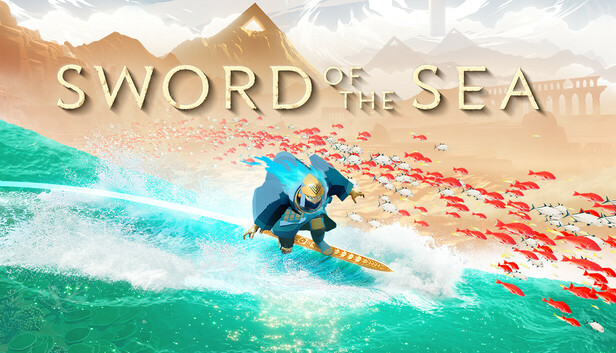
Sword of the Sea has found an unusually constructive use for a large blade: stand on it and go surfing. Giant Squid's single-player adventure sends the Wraith across a world of shifting terrain to restore a lost ocean, mixing tricks and exploration rather than treating the landscape as empty space between destinations. The original full release arrived August 19, 2025. This is a game whose basic proposition sounds like somebody misread the instructions for both surfing and sword ownership. Fortunately, that misunderstanding has a point.
Surfing a moving world
The important technical trick is underneath the board. In a June 2025 Epic Games interview, creative director Matt Nava explained that the terrain must update every frame, with the character responding to its changing surface rather than colliding with a static landscape. He connects that work to the player's decisions about steering through moving waves. That makes the shifting sand more than expensive wallpaper. A hill that changes while you approach it asks a different question from a ramp patiently waiting for your appointment. A route is interesting as something to read in motion, not merely memorize. It also makes speed more interesting than a bigger number: momentum becomes a negotiation with the ground, which has apparently declined to remain ground for contractual reasons. The scenery participates instead of posing.
A separate August interview with But Why Tho clarifies the generosity behind the movement. Nava describes the triple jump as a way to recover from mistakes, part of a deliberate attempt to stop treating every failed maneuver as grounds for a reset. The aim is expressive surfing, not a platforming examination administered by a disappointed cliff. That choice changes what experimentation costs. If an ambitious leap can become a correction rather than an immediate restart, there is less reason to choose the dullest safe route. It is not the same promise as demanding stunt mastery, and players seeking strict execution tests should recognize the difference. This design asks whether you can become more adventurous with the tools, rather than whether you have earned permission to enjoy moving in the first place.
Music, colour and identity
The music has a similarly concrete design behind its atmosphere. In his December 2025 Laced interview, composer Austin Wintory explains how children's voices became a proxy for the Wraith's developing identity, contrasted with a markedly different men's choir. Mixed adult voices provide an intermediate step rather than simply switching emotional channels without warning. That is useful context for a score doing narrative work: changes of vocal character can suggest development without a narrator stopping the ride to announce that personal growth has occurred. There is also an agreeable absurdity to the origin story, which involved Werner Herzog imagining skateboarding accompanied by a church choir. Sometimes artistic direction arrives as a detailed brief; sometimes it arrives wearing Herzog's voice. The serious idea beneath it is that movement can carry weight without ceasing to be playful.
Nava's April 2026 ABC interview offers a less obvious way to read the familiar palette. He says he had avoided orange because it recalled Journey, a project completed early in his career whose reputation made returning to that territory daunting. Sword of the Sea represents a willingness to revisit it rather than pretending the association does not exist. That does not make visual familiarity automatically good or bad. It makes the relevant question what the artist does with it now. A recognizable color can be a vocabulary word, not necessarily a photocopy. There is something refreshingly practical about treating creative confidence as the ability to use orange again. Artistic reinvention occasionally requires a radical manifesto; occasionally it requires reopening the paint drawer.
Collectible tracking and PC maintenance
The PC maintenance record is more useful than vague assurances. September 2025 updates added collectible tracking and photo-mode controls, followed by a fix for an achievement failing through chapter select. October 29, 2026’s patch 1.6 adds DLSS, graphics presets, performance optimisations and photo-mode fixes. The older September 19, 2025 notes reported startup crashes on some Intel Arc GPUs; the later patch does not specifically confirm that issue resolved. That is a reason to check current compatibility for your exact hardware, not proof that every Intel Arc system still crashes. Buy into the surfing idea, not an unmeasured performance guarantee.
SteamWavesRecoveryMusicPaletteUpdateFixLaunchSeptember 19, 2025 — historical PC patch notes and Intel Arc caveatSeptember 23, 2025 — chapter-select achievement fixOctober 29, 2026 — patch 1.6: DLSS, presets and performance updates