Quick Review
SPORTAL gives the monster-shooter formula a sporting equipment cupboard and an appropriately questionable sense of responsibility. Ricocheting pucks, arcing projectiles and timed swings make the arsenal's appeal its different tactical jobs, backed by deliberately rough retro creatures. Weapon balance and the length of a run matter beyond the first laugh, so this is a better fit for experimenting with oddball tools than expecting conventional gunplay. Bring an appetite for arena combat and deeply unsportsmanlike conduct.
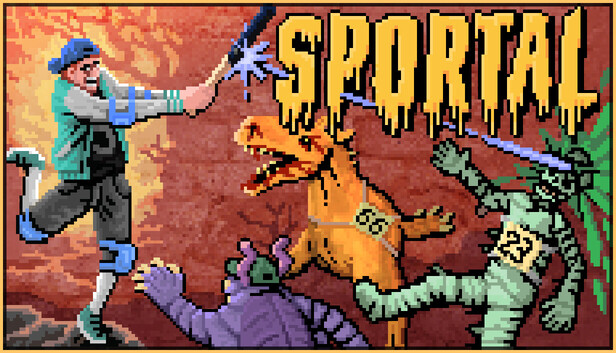
SPORTAL turns sporting equipment into weapons against movie monsters. Released on June 11, 2026, this single-player shooter has a sensible response to a world full of horrible creatures: apparently, the PE cupboard was unlocked.
A sporting arsenal with different rules
The interesting part is how differently those weapons were designed to work. In the team's hockey development diary, a puck travels from one enemy to another, exchanging the force of an individual hit for damage spread across a crowd. That is a more useful distinction than painting another gun blue. It makes the arrangement of enemies matter: a cluster is an opportunity rather than merely a larger problem. The diary also separates weapon types from their numerous configurations, an important distinction when a game starts waving impressive equipment totals around. A hundred variations do not automatically mean a hundred different things to learn. Here, the stated aim was to give each sporting discipline its own job. Distinguish the discussion's design intention from evidence of the precise damage or ricochet limits of today's build.
An earlier aiming diary gets unusually specific about the problems this creates. The slingshot used a familiar central crosshair, but its projectile still dropped during flight. Other implements drew a curved trajectory, with baseball adding the timing of the swing. The developers describe introducing slow motion because lining up a moving target and then connecting with it was too difficult without help. It is a revealing bit of design history: the sports joke had consequences for the controls. A bat cannot simply pretend to be a rifle and hope nobody notices. These are accounts of development choices, not a hands-on verdict on the finished aiming. They nevertheless explain why this peculiar arsenal needed more thought than replacing bullets with balls and clocking off.
Retro monsters with an athletic identity
The artwork follows a similarly deliberate process. In their texture diary, the team describe stripping away gloss and metallic effects, then reducing texture colours to get a rougher, older look. Monster surfaces receive additional painted details and shadows. That is a more concrete explanation of a retro aesthetic than simply announcing that the nineties have returned. The ugliness is being carefully manufactured. There is something pleasing about spending modern tools and patient labour on a creature that looks as though it has been stored in a damp computer room. The account is about the artistic method, not a claim that every scene achieves the same readability.
The creature diary has an especially good example of how an absurd idea acquires a practical role. Hors began with a disturbing horse meme and became a charging, toothy threat. Barrelman was adapted from a character in the team's earlier work, made smaller, and given a rush-and-explode attack. Those descriptions distinguish two kinds of approaching nuisance rather than just two costumes. They also make the comedy less random: the alarming shapes come with intentions. This is the developers explaining their creature concepts, not a promise that every encounter behaves exactly as an early diary describes. Even so, the exploding barrel-headed fellow sounds like somebody whose workplace should have offered counselling.
The sports identity itself needed another pass. According to a later diary, testers repeatedly wanted more of it, despite all the athletic equipment. The team responded with details such as a mummy's cap, pads and sports number, plus arena signage and progress displays. It is a useful distinction between making a joke available and making it legible. A monster carrying sporting accessories communicates the premise before anyone reads a description. The diary documents that visual direction; it does not prove that every proposed accessory reached release. Still, the notion of an ancient curse carefully dressed for training is a better use of a baseball cap than most corporate giveaways.
Balance changes and the shape of a run
The August update supplies a less theoretical caveat. Upgrade prices and coin drops were adjusted; masks, frisbees and bowling-ball turrets were toned down, and extra arenas were added because players were reaching the final boss too quickly. Those are consequential changes to the length and shape of a run, not just housekeeping. The developers wanted the challenge to last longer, although it takes more than patch notes to judge whether every adjustment lands perfectly. That leaves a clear question for this sporting horror show: does the equipment keep producing interesting decisions once the initial joke has landed? The documented balance work at least tackles that question rather than assuming a ridiculous weapon can carry an entire game by itself.
SteamLaunchHockeyAimingTexturesMonstersSport designBalance