Split Fiction Review
Quick Review
Split Fiction sends two partners through contrasting sci-fi and fantasy worlds, with shifting abilities and optional detours keeping cooperation delightfully unpredictable. Friend's Pass and individual accessibility settings help differently equipped players join the same adventure. A reliable companion is essential, and the constant changes may frustrate anyone wanting one familiar challenge to master. For a pair happy to coordinate, experiment and occasionally become pigs, it offers a wonderfully peculiar shared itinerary.
Split Fiction puts two people in charge of escaping a spectacularly bad publishing arrangement. Hazelight's cooperative adventure first arrived on March 6, 2025. The compulsory companion is both its selling point and its first practical hurdle: this is a game to plan with somebody, not a solo purchase with a multiplayer button gathering dust.
Two writers and their unfinished worlds
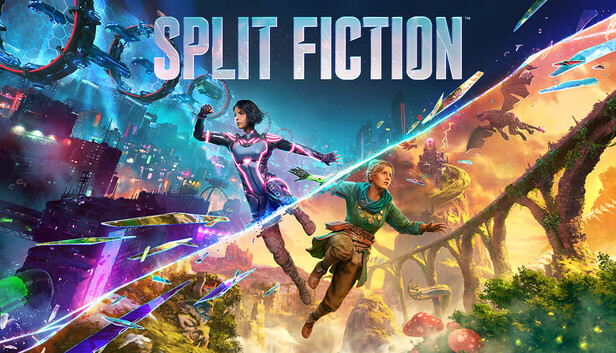
Mio writes science fiction; Zoe prefers fantasy. Both unpublished authors turn up at Rader Publishing hoping for a deal and end up trapped inside simulations of their work. A rejection email would have been less dramatic. Their contrast gives the premise more shape than simply switching the scenery from lasers to dragons. Mio is reserved and needs the money; Zoe is outgoing and wants to prove herself to her family. Those are different reasons to accept the same dubious invitation. Their imagined worlds also feed their abilities, from Mio's remote-controlled drones to Zoe's shapeshifting. The useful idea is that learning to cooperate involves entering somebody else's imagination, not merely standing on two pressure plates while maintaining a professional silence.
The optional Side Stories make that imagination feel less tidy. Portals lead to unfinished ideas from the authors' younger years, including hazardous snowboarding, a spacewalk gone wrong and a pig transformation with unfortunate sausage-related implications. Your abandoned childhood writing folder is probably safer left unopened. These detours return the pair to the main level afterward, so their purpose is variety rather than replacing the central journey. Hazelight connects their creation to its internal game jams, which is a convincing explanation for the gleeful changes of direction. The attraction is clear for partners who like being surprised together. Anyone who wants one consistent kind of challenge should also notice what is being offered: deliberate interruption, not a promise to settle into one comfortable groove.
Bringing a partner and adjusting the challenge
Friend's Pass addresses the least romantic part of cooperative gaming: persuading somebody else to buy the thing you are enthusiastic about. One owner can invite a partner who downloads the free pass, with cross-play allowing different supported systems to connect. Cross-play requires an EA account, and the pass requires an internet connection and applicable platform account. Two people who own neither copy can also try the opening stages together before one buys it. That is particularly sensible here. A trailer can sell you on a dragon; it cannot establish whether your schedules overlap or whether your partner regards coordinated platforming as a pleasant evening. Try being a team before committing to the team-building retreat.
The accessibility options deserve attention before frustration becomes the evening's main activity. Controls can be remapped separately for each player, camera settings can be adjusted individually, and repeated button presses can become holds or automatic completion. There is also a checkpoint-skip option and a reduced-damage setting that prevents deaths from certain enemy attacks. These are meaningful choices for a pair with different needs, rather than insisting that cooperation means identical dexterity. Checkpoint skipping has a trade-off: skipping still means missing that section, an escape hatch rather than an alternative version of its challenge. But preserving the shared evening can matter more than proving that both people can satisfy the same input demand. A friendship does not need a certification exam.
The March 17 update provides a nicely specific reminder that elaborate set pieces have ordinary technical weak spots. It fixed a Royal Palace wheel puzzle that failed to move quickly enough above 150 frames per second, corrected a harpoon's handling of camera sensitivity and clarified tutorial prompts in Walking Stick of Doom. Faster hardware should not make a wheel less cooperative. These are documented repairs, not grounds for declaring every version flawless. They do, however, show attention to a particularly important issue in a two-person adventure: an unclear instruction or broken interaction can waste two people's time while each wonders whether the other has missed something.
Platform sharing and PC support
The later Nintendo Switch 2 release preserves the same story and gameplay while adding another useful way to bring someone along. Local wireless GameShare lets a Switch 2 owner share with another Switch 2 or an original Switch. That last detail needs its asterisk: the original Switch participates through GameShare, rather than having a standalone version to buy. Friend's Pass and cross-play are also supported on Switch 2. The interesting benefit is flexibility, not a fresh game hiding under a platform label. Choose the arrangement that gets both people comfortably involved; an extra piece of hardware is not automatically an extra reason to play through the same adventure.
On Steam, the game does not require the EA app, and the publisher documents Steam Friends invitations, cloud saves and ultrawide support. Those are sensible conveniences around a game already asking you to coordinate with another human. The cloud-save support also makes moving between a PC and Steam Deck less awkward. The appeal of these provisions is practical: fewer steps between agreeing to play and actually starting. A feature checklist should not be mistaken for measured performance on your own hardware. Convenience is worth having without promoting a compatibility checklist into a personal benchmark.
SteamCharactersSide storiesFriend’s PassAccessibilityMarch updateSwitch 2PC featuresLaunch