Quick Review
Spilled! turns cleaning polluted water into a pleasing loop of collecting oil, recycling it and improving your little boat. Watching murky scenery recover gives each pass an immediate reward, with animal rescues adding modest reasons to explore. The adventure is deliberately brief and mechanically light, while pushing loose rubbish can be awkward. It is a lovely fit for players wanting a gentle cleanup they can actually finish, rather than deep planning or endless progression.
In this review
Reasons to look closer · A recycling trip is the whole business plan · The bottles have declined to join the queue · Restoration is the scenery, not just the reward screen · More tools, without a surprise second career · The verdict: a small cleanup with a proper stopping point · Sources
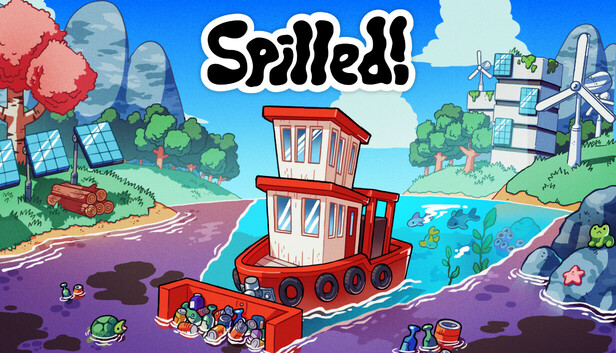
The ocean in Spilled! has a straightforward request: please remove the horrible stuff floating in it. Your response is a small boat, some cleaning equipment and a willingness to make repeated trips to the recycling point. There is no need to assemble a multinational logistics company first. Lente’s single-player cleanup game [1] turns oil, rubbish and damaged scenery into a compact sequence of visible improvements. It is a pleasingly direct arrangement: do something useful, watch the water recover, collect enough coins to do the useful thing more efficiently.
The full game arrived on March 26, 2025 [2], following earlier demos, and it knows exactly how small it wants to be. Eight areas and an advertised playtime of around an hour establish the scale before the boat leaves the dock. That is a complete little outing, not the opening shift of an infinite cleaning career. Its strength is the clarity of its feedback; its limitation is how quickly the routine exhausts its variations.
Reasons to look closer
Look closer if a satisfying before-and-after picture can sell you on a game faster than a complicated skill tree. Spilled! gives you a practical task with a visible result, then lets you get on with it. The modest length also makes room for the unfashionable pleasure of actually finishing something. It is less appealing if you need deep planning, difficult objectives or a steadily expanding machine to manage. This boat has cleaning equipment, not a business-development department hiding under the seat.
A recycling trip is the whole business plan
The central loop is easy to understand: collect oil until the boat’s tank fills, unload at the recycling vessel, then spend the proceeds on improvements. So Many Games describes three upgrade tracks [5]: a wider collector, greater storage capacity and more speed. Each improves a different source of friction. Capacity reduces return trips; width makes a pass through a slick more productive; speed reduces travel time. These are not elaborate build choices, but their effects are pleasantly concrete.
That simplicity is both sensible and restrictive. There is a useful rhythm in alternating slow cleanup with a quick return to unload, but no hidden strategic ocean beneath it. The upgrades make the same job easier rather than transforming it into another game. Anyone hoping to optimise supply chains or discover wildly different boat builds should adjust expectations before setting sail.
The bottles have declined to join the queue
Oil is conveniently absorbed into storage. Loose rubbish is less cooperative: bottles have to be gathered and pushed toward recycling, so steering and positioning become more important. Finger Guns found herding debris and manoeuvring in tight spaces awkward [6], despite enjoying the generally accessible controls. This is the difference between a vacuum cleaner and a shopping trolley with opinions. The physical handling gives the boat some presence, but it can also interrupt the clean, frictionless satisfaction the rest of the design is trying to provide.
There is a distinction between that intentional handling and actual technical trouble. Gaming Respawn’s launch review reported trapped rubbish and unreachable oil [7]. Lente’s April 12, 2025 patch notes [2] subsequently addressed an area-six completion issue involving bottles clipping outside the level, while acknowledging that other reported bugs remained. When comparing PC game reviews with later patch notes, that does not establish the condition of every current build, but it does make the historical criticism more specific. The sensible expectation is a charming small game, not a guarantee that every last scrap will always obey the harbourmaster.
Restoration is the scenery, not just the reward screen
Spilled! benefits from making environmental improvement readable while you work. Water loses its murky appearance, and the recovered scenery becomes the place you continue navigating rather than a result tucked away in a menu. Gaming Respawn praised the changing colours and calm musical accompaniment [7]. Cleaning one more patch is attractive because it changes the view in front of the boat. The artwork is not merely making the chore prettier; it helps explain why the chore matters.
The 16 rescue animals [3] give exploration another modest incentive, and different biomes prevent every stretch of water from looking interchangeable. That restraint suits the game: rescuing an animal does not need to open three tabs about feeding schedules and enclosure optimisation. It also means the side attractions cannot compensate if the basic cleanup loop does nothing for you. The extras add personality to an already appealing activity; they do not supply an entirely different reason to keep playing.
More tools, without a surprise second career
The later areas add jobs such as washing polluted surfaces and putting out fires, widening the routine without demanding much extra study. Finger Guns found that the additional tasks offered limited mechanical depth [6], even as their rewards helped keep the journey pleasant. That is a fair description of the tradeoff. A new task changes what your boat is attending to, not the underlying level of challenge. The game remains approachable throughout, but players waiting for an unexpectedly intricate second act will mostly find more things that need a good rinse.
There is at least a useful way to judge that modest loop before committing on mobile. The Android version [4] and iPhone and iPad version [3] offer the first three zones free, with a single purchase unlocking the rest. That is particularly helpful for a game whose appeal depends on whether moving this little vessel around feels satisfying to you. The level selector also lets you revisit completed areas. Repetition here is a choice to return to a familiar, calming activity, rather than a promise of endlessly generated new work.
The verdict: a small cleanup with a proper stopping point
The obvious criticism is that the voyage ends quickly. So Many Games wanted more areas [5], while still appreciating the deliberate small scale. For something this compact, the more substantial question is what another few hours would add. Spilled! has enough variation for a brief excursion, but the light upgrade system and straightforward tasks are not obviously improved just by multiplying the amount of oil between the starting point and the credits.
That makes the recommendation fairly clear. Choose Spilled! for a gentle, visually rewarding cleanup you can finish without rearranging your week. Pass if value means a long campaign, substantial mastery or an endless collection of fresh scenarios. The occasionally fiddly debris is a genuine blemish, and the short runtime should be treated as part of the purchase decision rather than disguised as a shocking plot twist. Within those limits, the game has a lovely sense of proportion. The boat gets a job, does something worthwhile and is allowed to clock off.
Sources
Source links correspond to the numbered references in this review.
[1] Steam — official Windows/macOS release, developer, publisher and game details • [2] Lente’s Steam announcements — March 26 launch, earlier demos and April 12 bug fixes • [3] Apple App Store — released iPhone/iPad edition, publisher and full-game unlock • [4] Google Play — released Android edition and free first three zones • [5] So Many Games — Christopher Lannoo’s full review, March 24, 2025 • [6] Finger Guns — Miles Thompson’s full PC review, March 13, 2025 • [7] Gaming Respawn — Will Worrall’s full review, April 1, 2025