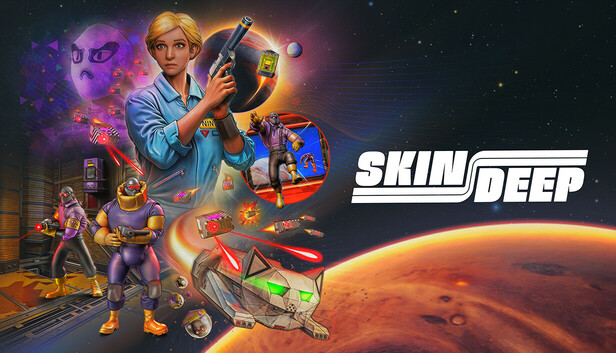
Quick Review
Skin Deep turns pirate-filled spaceships into playgrounds for improvised stealth, where clutter, hazards and breakable windows can become a plan. Learning object interactions provides satisfying progress without a giant upgrade tree, and chaotic mistakes often produce useful information alongside the comedy. Repeated rescue objectives and dependable tricks can make later missions feel familiar. It suits curious players who invent alternatives for fun, rather than those who want the safest solution to keep changing automatically.
In this review
Introduction • Reasons to look closer • Your equipment budget is whatever is lying around • A terrible plan can still be an interesting plan • Space is another corridor, and the pirates need disposal • The joke needs you to keep experimenting • A strong invitation to make a small, elaborate mess • Sources
Skin Deep has a persuasive answer to the question of what a professional space operative needs: preferably shoes, but apparently nobody approved the expense. Blendo Games' first-person adventure puts a lightly equipped insurance commando aboard ships overrun by pirates, with imprisoned cats to rescue and ordinary objects awaiting deeply irresponsible uses. It released on 30 April 2025 [1] for Windows PC. The developer also lists Steam Deck verification, controller support and mod support. The assignment is serious. Almost everything surrounding it is wonderfully stupid. Deck verification is useful compatibility context, not a reason to assume a specific frame rate on a different machine.
The appeal is figuring out how a place works, then making those rules somebody else's problem. Sneaking, stealing and improvising matter more than arriving with an impressive gun collection. If your favourite stealth moment is the ingenious recovery after a plan falls apart, this is promising territory. If you want a smooth procession of clean headshots, the cats may need another contractor.
Reasons to look closer
Small, interconnected ships give experimentation a manageable scale, while vulnerable enemies, strange equipment and everyday clutter offer more interesting questions than which ammunition to buy. The comedy comes partly from your own decisions colliding with the simulation, so it has room for surprises beyond the written jokes. The improvisational possibilities come with caveats: repeated objectives can make later jobs feel familiar, and the game asks you to enjoy learning its systems. The enticing part is that learning can involve a banana peel rather than a spreadsheet.
Your equipment budget is whatever is lying around
The absence of a giant upgrade tree gives Skin Deep a useful focus. GameSpot describes progression through knowledge rather than purchased skills [3]: understanding an object's properties makes it more valuable without changing its statistics. A copying device can duplicate a useful key; pepper can interrupt a pirate; a damaged radio can provide an ignition source. The same room changes character once those possibilities start making sense. You have not acquired a new power so much as developed a worrying interest in the cleaning supplies.
That makes attention feel worthwhile. Looking around is part of equipping yourself, and the equipment is tied to the place rather than pulled from an endlessly expanding backpack catalogue. It also means the game cannot do the curiosity for you. Repeating a dependable trick may work perfectly well, but it leaves some of the pleasure untouched. Treating the environment as a collection of possible verbs is the invitation.
A terrible plan can still be an interesting plan
The systems become especially attractive when they interact. Breakable windows, moving objects and environmental hazards create consequences that extend beyond the target you originally had in mind. PC Gamer's review highlights that chain-reaction design [4], including an event log that helps explain particularly chaotic outcomes. A game that can require a post-incident reconstruction has understood something important about giving people access to explosives.
The benefit is that failure can produce information rather than merely another attempt at the same button sequence. A catastrophe teaches you what the room contains and how its pieces behave. The danger is confusion: if you need every result to be immediately tidy and legible, emergent slapstick can look suspiciously like a collection of things happening without permission. Skin Deep suits the player willing to pause, work out why everything exploded, and then make a slightly more informed mistake. Its comedy and its learning process are closely related.
Space is another corridor, and the pirates need disposal
Ship interiors are only part of the route-finding problem. Nina can survive outside in space, opening up the possibility of navigating around a locked interior route rather than politely accepting the door's opinion. GamesRadar describes that exterior exploration alongside the Skullsaver system [5]: defeated pirates can return unless their preserved heads are properly disposed of. Taking somebody out creates a second task. The paperwork has become anatomical.
This is a clever complication because an apparently successful encounter still needs finishing. Carrying away the evidence matters mechanically, while the talking heads keep the tone from becoming solemn. Routes, hazards and cleanup become connected decisions instead of separate checkboxes. The absurdity also helps the rules stick: a regenerating space pirate is easier to remember than another anonymous enemy health bar. Just do not confuse a funny premise with a promise of effortless play. There is still a hostile ship to understand, and its occupants have very definite objections to your presence.
The joke needs you to keep experimenting
The limitation is the structure underneath the wonderful nonsense. Free cats, find access, deal with security, escape: the recurring work can become familiar before the campaign ends. Digital Trends found the ships and solutions too repetitive [6], while GameSpot similarly noted how reliable some tactics become. That disagreement with the game's more enthusiastic reception identifies the useful buying question: will you invent another approach when the old one still works?
A player who naturally tests odd combinations can find fresh entertainment within familiar objectives. Someone who optimises toward the safest answer may expose the repetition sooner. Neither approach is wrong; they simply draw different things from this design. Skin Deep gives you room to be mischievous, but freedom is less persuasive when you want the game to insist on fresh challenges. The cheerful visual style cannot conceal that distinction. Enjoying the first ridiculous interaction is a good start, not proof that every subsequent ship will feel equally new.
A strong invitation to make a small, elaborate mess
The official FAQ estimates roughly ten to twelve hours [2], a useful indication of scale rather than a personal completion time. This is a contained campaign, with modding tools and Steam Workshop support for players interested in exploring further. It does not need a hundred-hour commitment to justify asking you to understand its strange little workplace. Curiosity is the more important investment.
Skin Deep makes its best case through the relationship between a vulnerable operative and an unusually cooperative collection of objects. It offers enough structure to give your meddling a purpose, then lets that meddling generate the entertainment. The repeated rescue framework makes it a less obvious choice for anyone seeking constant mechanical reinvention, but the mixture of stealth, comedy and practical experimentation is distinctive. Come for the cats if you like. Stay because a room full of apparently useless objects has started looking like a plan, and because you are now reasonably certain which window not to break.
Sources
Source links correspond to the numbered references in this review.
[1] Steam — release date, developer, publisher and single-player listing • [2] Blendo Games — official FAQ, platforms, features and estimated length • [3] GameSpot — Skin Deep review by Mark Delaney • [4] PC Gamer — Skin Deep review by Morgan Park • [5] GamesRadar — Skin Deep review by Joe Chivers • [6] Digital Trends — Skin Deep review by Giovanni Colantonio • [7] Blendo Games — launch announcement, 30 April 2025