Quick Review
Rosewater offers a leisurely Western road trip built around conversation, inventory puzzles and a travelling cast worth getting to know. Alternate solutions and companion contributions make practical problems feel more flexible than a single hidden-answer test. The many detours weaken the treasure hunt's urgency, and occasional minigames are less convincing. Patient point-and-click fans who value company and meaningful local choices should enjoy the journey more than players chasing a tightly paced mystery.
In this review
Reasons to look closer · A reporter is a useful person to take nosing around · Inventory puzzles that allow a second sensible idea · The main plot occasionally rides in the luggage · A handsome Western with a few awkward interruptions · Verdict: Book the trip for the people, not the deadline · Sources
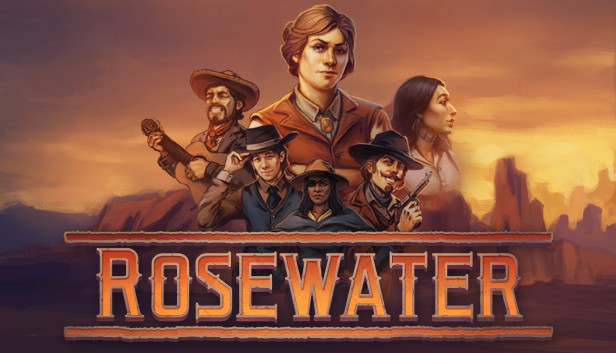
Rosewater begins with a perfectly reasonable newspaper assignment and develops the kind of complications that make an editor regret approving travel expenses. Harley Leger arrives looking for writing work, only to end up pursuing a missing man's fortune across Western Vespuccia. Released on March 27, 2025 [1], Grundislav Games' point-and-click adventure trades the solitary gunslinger for a wagon full of personalities. There is treasure somewhere ahead, but apparently everyone has agreed to investigate absolutely everything on the way.
That leisurely disposition is both its charm and its central caveat. Rosewater offers a substantial journey built around conversations, inventory puzzles and relationships rather than a tightly wound chase. The companions are more than passengers, and alternate solutions give practical problems a welcome social dimension. Still, a road trip can be lovely without being especially urgent. Anyone arriving for a relentlessly escalating mystery should know that this wagon has excellent company and an extremely generous interpretation of the phrase 'quick stop.'
Reasons to look closer
Look closer if you want a traditional adventure that makes room for different approaches without abandoning its authored story. Rosewater combines an accessible inventory format with a sizeable travelling cast, expressive animation and a Western setting interested in people as much as danger. Its branching details encourage curiosity rather than perfectionism. For readers seeking a memorable cast, the strongest reason to stay is the company; the weakest reason to buy is expecting thriller-like momentum through every conversation, campsite and roadside complication.
A reporter is a useful person to take nosing around
Harley's profession gives the familiar adventure-game habit of questioning everybody a purpose beyond rampant nosiness. Her search for a story expands into a five-companion expedition [4], turning a personal opportunity into an ensemble journey. The setting shares a world with Lamplight City, but RPGFan confirms this is a standalone tale [7]. There is no need to complete another detective's paperwork before boarding. The useful connection is atmosphere: an invented historical world can borrow Western imagery without being restricted to a textbook itinerary.
The group also changes what competence looks like. Harley doesn't have to be the finest shot, the best specialist and the person with every answer. Other characters can contribute, and how she treats them matters. That is a healthier foundation for a travelling party than five decorative people watching the protagonist solve their entire lives. It also makes conversation feel potentially practical: getting to know somebody may reveal an approach to the immediate problem, rather than merely another page of optional biography.
Inventory puzzles that allow a second sensible idea
MonsterVine's Samantha Lienhard highlights alternate solutions [5], including an obstacle that can be cleared through different distractions. That flexibility matters more than a raw puzzle count. A point-and-click adventure becomes less brittle when a plausible plan can work without perfectly matching one hidden sentence in the designer's head. It doesn't remove the pleasure of figuring things out; it gives that figuring-out process room to express a preference. Sometimes diplomacy is the plan. Sometimes the plan involves an alarming interest in fire.
The same review notes hotspot highlighting, quick movement and companion advice, all useful ways of reducing friction around the actual deduction. Those conveniences do not make every answer obvious, nor should they. The goal is to distinguish being stuck on a problem from being stuck because a tiny object escaped the cursor. Consequences and companion reactions can vary with the approach, too. That gives a solved puzzle a little afterlife instead of letting it evaporate the moment the relevant doorway opens.
The main plot occasionally rides in the luggage
The journey uses randomised encounter storylets [1], with circumstances and outcomes influenced by earlier choices and available resources. Structurally, that invites a collection of smaller adventures rather than one uninterrupted chain of revelations. There is real value in giving a place room to exist beyond the protagonist's objective. Strangers shouldn't have to become essential clues before they deserve attention. But the trade is obvious: every interesting diversion also puts another mile between the player and the reason the wagon left town.
PC Gamer's Maddi Chilton found that relaxed rhythm could drift towards aimlessness [6], while MonsterVine similarly wanted more momentum behind the central hunt. These are not complaints that the game lacks incidents; they concern how those incidents accumulate. A busy itinerary can still feel dramatically static. The distinction is useful when deciding whether Rosewater fits your mood. Choose it for a wandering ensemble adventure, not because the treasure premise promises a taut race. Nobody here appears to be charging by the mile.
A handsome Western with a few awkward interruptions
The presentation makes a clear effort to give conversations and travel their own spectacle. Rotoscoped animation, cinematic close-ups and Mark Benis' score with live instruments [2] support a fully voiced cast. That is a sensible investment for a game whose appeal depends heavily on spending time with people. Visual personality and musical warmth can carry an ordinary exchange without requiring a gunfight to wake the screen up. The Western isn't merely a set of hats pasted onto a succession of locked doors.
Not every change of activity earns the same enthusiasm. PC Gamer found the occasional minigames less successful than the central adventure, particularly the shooting diversions. RPGFan was more positive about the overall journey but noted some uneven backgrounds and occasionally choppy animation. Those observations suggest a production with character rather than immaculate consistency. When weighing the praise in video game reviews, expect the presentation to enrich the trip, not erase its slower stretches. A lovingly animated wagon is still capable of taking the scenic route when you would rather reach the next town.
Verdict: Book the trip for the people, not the deadline
Rosewater's best idea is letting the party's relationships and the adventure's practical problems inhabit the same space. Different solutions needn't lead to wholly different games to be worthwhile; changing the immediate outcome or how somebody sees Harley can be enough. RPGFan describes an essentially linear journey with meaningful variation in relationships and side stories [7], a more useful expectation than imagining a limitless branching frontier. There is room to leave fingerprints on the trip without being handed the entire mapmaker's job.
It is a strong prospect for patient adventure fans who enjoy dialogue, flexible puzzles and a cast that has time to become familiar. It is less convincing as a recommendation for anyone who values narrative urgency above all else. That division isn't a minor footnote; it is the character of the game. Rosewater wants to be remembered as a journey shared with particular people, not a checklist completed at record speed. The fortune can wait. Someone has spotted another problem beside the road, and the wagon is already stopping.
Sources
Source links correspond to the numbered references in this review.
[1] Steam — Rosewater release, developer, publisher and encounter systems • [2] Application Systems Heidelberg — Rosewater official platforms, animation and soundtrack features • [3] GOG — Rosewater release date, Windows/macOS/Linux support, genres and single-player mode • [4] Grundislav Games — Rosewater official overview and companion features • [5] MonsterVine — Samantha Lienhard, Rosewater review (March 31, 2025) • [6] PC Gamer — Maddi Chilton, Rosewater review (March 31, 2025) • [7] RPGFan — Tina Olah, Rosewater review (April 30, 2025)