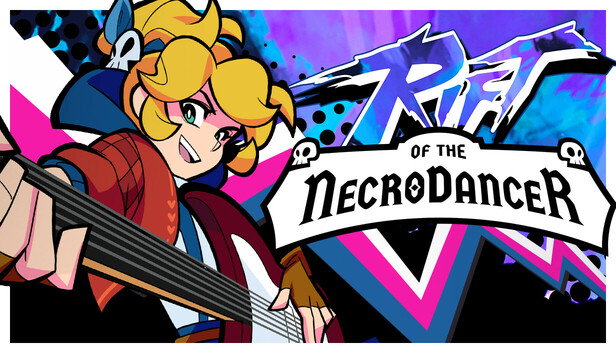
Quick Review
Rift of the NecroDancer makes rhythm play a lively translation exercise: monsters change lanes or demand multiple hits, so recognising behaviour matters alongside timing. Learning that visual vocabulary gives its strong original music a distinctive challenge beyond conventional note charts. Steep difficulty jumps and dense information can interrupt the flow, with campaign diversions of mixed quality. It is a rewarding prospect for rhythm fans who enjoy studying patterns, but not another dungeon-crawling adventure.
In this review
Reasons to look closer · Three lanes, several extremely unreliable commuters · Difficulty options help, but they cannot learn the monsters for you · The soundtrack is a headline act, not a nostalgia service · Even the undead have errands between performances · The verdict: a brilliant idea with a substantial learning curve · Sources
Usually, the notes in a rhythm game have the decency to stay where the chart puts them. Rift of the NecroDancer gives them monster bodies and worse manners. Cadence is pulled into a modern world where musical combat means reading a stream of creatures, predicting their behaviour and hitting them on time. This spin-off from Brace Yourself Games and Tic Toc Games [2] replaces dungeon exploration with something closer to a musical entrance exam conducted by bats.
The full game launched on Windows on February 5, 2025 [1], followed by Nintendo Switch on March 27 [3]. Despite the familiar faces, this is not simply more Crypt of the NecroDancer. There is no dungeon build to rescue a shaky performance. Its central appeal is learning how the creatures translate into button presses, then putting that knowledge to work without losing the beat. It is inventive, energetic and occasionally rather a lot to ask of a brain that came here because it liked the song.
Reasons to look closer
Look closer if you enjoy rhythm games but want something beyond increasingly crowded rows of familiar symbols. Rift makes interpretation part of the performance: knowing what an enemy will do matters as much as tapping at the right moment. Its cartoon confidence and musical range keep that challenge inviting. Just do not mistake the cheerful presentation for a gentle difficulty curve. Learning complicated patterns must be part of the attraction.
Three lanes, several extremely unreliable commuters
The main Rhythm Rifts send enemies down three lanes. A basic slime is straightforward, but tougher creatures need repeated hits, and bats can change lanes after an attack. The publisher’s description makes those behaviours explicit [3]: recognising a monster tells you what sequence is coming, not merely where to press once. This creates a neat little translation problem. You see one creature, anticipate several inputs, then slot those inputs between whatever else is approaching.
Nintendo Life praised the added pattern-reading challenge [4], and that gets to Rift’s most interesting distinction. A conventional chart can be difficult because it demands quick, precise execution. Here, the instructions themselves must first be decoded. That gives mastering an enemy a satisfying permanence: the knowledge is useful beyond one particular song. It can also feel like extra homework placed between you and the music. If your favourite rhythm-game pleasure is disappearing into a familiar track, these creatures may keep dragging you back into conscious calculation.
Difficulty options help, but they cannot learn the monsters for you
The four difficulty levels run from Easy through Impossible [1], with room to find a manageable starting point. Nevertheless, the change in complexity is not just a faster conveyor belt. More demanding combinations require you to keep several enemy rules active at once. Nintendo Life found the jump between settings substantial. A lower difficulty can let you enjoy a song and learn its pulse, but moving upward still asks you to acquire the game’s visual vocabulary.
There are practical aids beyond lowering the setting. The June 11, 2026 Steam update reorganised the tutorials [7] around individual monsters, traps and concepts, making specific rules easier to revisit. The developer also explains how early/late hit indicators and manual calibration [8] can help distinguish timing problems from a poorly matched setup. That distinction matters in a game this demanding. Repeating the wrong lesson is not practice; it is just becoming increasingly annoyed with excellent musical accompaniment.
The soundtrack is a headline act, not a nostalgia service
Danny Baranowsky and a group of collaborators supply the original soundtrack [2], giving the game its own musical personality rather than relying entirely on recognition. The tunes have to support repeated attempts, and the range of styles helps keep the campaign from becoming one long exercise in the same mood. A monster-filled lane does not have to impersonate somebody else’s famous concert; it can be the setting for a performance with its own identity.
That does involve a tradeoff. Nintendo World Report enjoyed the soundtrack but missed the immediate familiarity of licensed favourites [6]. Knowing a chorus in advance can make learning its chart feel less forbidding. Meanwhile, Nintendo Life noted that the combat noises sometimes compete with the music. Those observations explain why strong songs do not automatically guarantee effortless flow. Rift wants you to hear the beat while reading enemy animations and interpreting attacks. The soundtrack is enjoyable company, but it does not remove the visual work the game places on top of it.
Even the undead have errands between performances
The campaign brings Cadence and familiar characters into an odd modern routine, with dialogue, bosses and minigames breaking up the lane battles. Shacknews highlighted the contrast between fantasy characters and ordinary workplaces [5], including the NecroDancer dealing with fast food. These interludes also stop the campaign from feeling like a spreadsheet of songs with cutscenes glued between the rows. The cast gets opportunities to do something besides stand beside the scrolling monsters.
The side activities are not equally substantial. Nintendo World Report particularly enjoyed the playful rhythm minigames [6], while Shacknews found the boss encounters comparatively shallow. That is a fair expectation to bring: the yoga and job-related diversions provide character and a change of pace, rather than another system with the depth of the main rifts. They can be welcome breaks without being the reason to buy the game.
The verdict: a brilliant idea with a substantial learning curve
There is plenty to revisit once the story stops directing traffic. Remix Mode changes beatmaps while preserving their rhythmic design [3], and daily challenges give players a shared seed to tackle. The Steam version also supports custom charts and Workshop content [1]; that is an extra route into experimentation, not something to assume exists identically in every edition. Paid music packs and free tracks expand the selection as well, so distinguish the base selection from later additions. The appeal is not just accumulating songs, but getting more fluent at interpreting the game’s unusual musical language.
Rift earns a recommendation for rhythm fans willing to enjoy the learning process itself. Its enemies are more than themed note icons: their behaviour meaningfully changes how a chart is read. Players drawn to that originality should also weigh its trade-off: a potentially intimidating amount of information, plus a campaign whose diversions vary in strength. Anyone seeking another dungeon-crawling RPG should look elsewhere. Anyone intrigued by a rhythm game that argues back has a far better reason to investigate. The bats are not going to become more polite, but understanding their nonsense is the point.
Sources
Source links correspond to the numbered references in this review.
[1] Steam — official Windows release, features, custom charts and current song offerings • [2] Brace Yourself Games press kit — developers, rhythm genre, release dates and soundtrack • [3] Nintendo — native Switch edition, publisher, player count, release and modes • [4] Nintendo Life — Roland Ingram’s full Switch review, April 7, 2025 • [5] Shacknews — Lucas White’s full PC review, February 12, 2025 • [6] Nintendo World Report — Willem Hilhorst’s full Switch review, April 1, 2025 • [7] Official Steam update — June 11, 2026 tutorial reorganisation • [8] Brace Yourself Games developer reply — early/late feedback and manual calibration