Promise Mascot Agency Review
Quick Review
Promise Mascot Agency ties an eccentric management sim to countryside exploration, letting you run the business from a truck while helping a struggling town. Distinctive mascot colleagues and physical comedy give the financial recovery a human, or at least unusually shaped, reason to matter. Its difficulty options affect specific systems rather than softening everything together. Pick it for characterful odd jobs and exploratory driving, especially if conventional office work needs fewer spreadsheets and more fence-grinding.
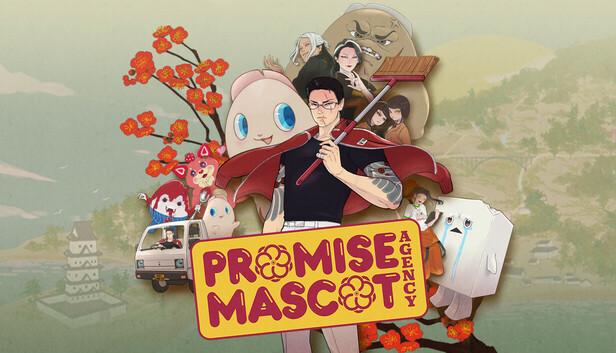
A disgraced yakuza rebuilding a bankrupt mascot agency sounds like somebody lost a bet during a pitch meeting. Promise Mascot Agency commits to it anyway. Michi arrives in cursed Kaso-Machi with a business to rescue and an exile to investigate, assisted by Pinky. The full game launched on April 10, 2025. Its mascots are living colleagues, not people waiting to take their costumes off.
A business connected to its town
The management side has a useful connection to the setting. In his post-launch RPG Site interview, director Oli Clarke Smith explains that the bankrupt business and rural depopulation themes were deliberately linked: activity in town feeds the agency, and the agency changes the town. He also describes abandoning an early calendar system in favour of mascots departing as soon as a job is accepted. That gives exploration a practical relationship with the business rather than making it a decorative break from a spreadsheet. Kaso-Machi is somewhere you are supposed to improve, not just strip for resources before leaving. The appeal is watching eccentric people and places become part of a functioning network. Financial recovery is a more interesting goal when it means helping this particular collection of oddballs, rather than merely persuading a number to become a larger number.
The truck keeps those activities moving together. In Maximum Utmost's interview, technical director Phil Crabtree describes rejecting a structure that repeatedly sent players back to the agency for management. Allowing that work from the vehicle made room for exploration instead of commuting. Clarke Smith also describes recovery systems intended to make a physics-based truck forgiving enough to throw around the countryside. Those are developer accounts of the design, not a claim that every landing will be graceful. They explain why the vehicle is more than a novelty skin over ordinary travel. A little truck can make the road itself part of the entertainment, while remote management prevents every interesting detour ending with another trip to the office. It is a rare business fantasy where operational efficiency means spending less time at headquarters. Someone should mention that to real managers.
Mascots with physical personalities
The mascots' physical awkwardness is another deliberate choice. Speaking separately to Loot Level Chill, Clarke Smith describes studying real mascot events and Japanese comedy programmes when planning their battles. The aim was to build surprising encounters around physical comedy, giving these bodies a reason to matter beyond looking peculiar in a character portrait. This is a better fit for the premise than handing every recruit a conventional sword and pretending their shape does not matter. He also explains art director Rachel Noy's interest in managing distinct characters rather than anonymous workers. That gives the absurdity a job to do. A memorable employee is someone you can worry about, not just an icon with a productivity rating. The agency's personnel department may have unusual requirements, but at least nobody can accuse the staff of being interchangeable.
Driving options and Prepare to Grind
Crabtree's accessibility interview with Xbox Wire offers a similarly practical view of the controls. He describes implementing tap-based driving and reversing rather than requiring held triggers, and thinking about how much pressure timers put on players who need longer to read. The team demonstrated the game with an Xbox Adaptive Controller and discussed testing alternative ways to accelerate and brake. That is evidence of a design process, not a claim that one controller arrangement suits everybody. It is encouraging precisely because the adjustments concern actions repeated throughout the adventure. An amusing drive can become a tiring one if its basic inputs demand more sustained effort than a player can comfortably provide. Giving someone another way to operate the truck preserves the journey's appeal instead of asking them to prove they deserve the keys.
The free Prepare to Grind update adds a less sensible use for those keys: an unlockable truck upgrade for sliding along metal fences and railway tracks. It also adds ten time trials, with separate difficulty settings and hero-card rewards for meeting their target times. Existing and completed saves can access the additions, so returning does not require rebuilding the business from nothing. The broader difficulty setting has a narrower effect than its name might suggest: the notes say it changes the money sent to Matriarch Shimazu, rather than every system in the game. PC players can also choose controller-prompt styles, a small but welcome aid when the picture on screen should match the device in hand. These are shipped features, not a future wish list. The result gives the truck more mischief to perform while leaving players some control over how demanding their second career becomes. Check which difficulty setting you are changing rather than assuming a single slider changes every system.
SteamManagement interviewTruck interviewMascot interviewInput interviewPrepare to GrindGrand opening