Quick Review
Pipistrello makes an expanding set of yoyo tricks useful for movement, puzzles and fights across an interconnected city. Revisiting streets with new techniques gives exploration real purpose, while badges and upgrade debts add choices about when to accept a temporary disadvantage. Repeated enemy-clearance rooms can interrupt the best navigation, and those financial drawbacks may slow momentum. It is a strong fit for curious action-adventure fans who enjoy mastering tools and uncovering secrets.
In this review
Introduction • Reasons to look closer • The pavement is now a suggestion • Ancient ruins have been replaced by commercial property • Congratulations on the upgrade, please enjoy the drawback • Sometimes the room just wants another fight • A small toy carrying a substantial adventure • Sources
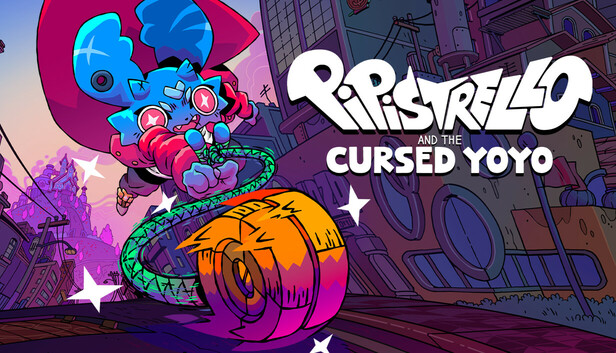
Pippit has chosen an unusual tool for dealing with organised crime. A yoyo is already a questionable answer to an armed confrontation; adding family responsibilities only makes the arrangement stranger. Pipistrello and the Cursed Yoyo sends its bat protagonist through a city controlled by rival business interests, turning a toy into a weapon, a travelling companion and an increasingly elaborate means of getting across the street.
Pocket Trap’s single-player adventure first released on 28 May 2025 [1]. Its top-down perspective and colourful pixel art invite comparisons with older Zelda games, but the pitch becomes more interesting once the yoyo starts changing how you navigate. This is for players who like a familiar area to reveal new possibilities after learning a move. Admiring the scenery is welcome. Working out whether you can bounce across it is the main event.
Reasons to look closer
The clever hook is that movement, puzzles and fighting all share the same expanding toybox. New yoyo techniques make earlier streets worth reconsidering, while badges and permanent upgrades give exploration rewards beyond another nice-looking corner. The city setting adds personality to familiar dungeon-adventure ideas, and difficulty settings provide room to adjust the challenge. Expect an active, secret-filled journey with some demanding stretches, rather than a relaxed sightseeing tour. Pippit is small; his capacity to make a simple route complicated is considerable.
The pavement is now a suggestion
The official description stresses combining yoyo tricks [2] to reach places and solve challenges in different ways. That flexibility is the promising part. An ability that opens a single matching door has performed a useful service, but a move that changes your relationship with several kinds of terrain gives you something to experiment with. The city becomes more interesting when a wall starts looking like part of a route.
It also makes learning the controls central to the enjoyment. You are building a vocabulary of actions, then deciding which ones belong together. Players who like movement puzzles have a reason to investigate an awkward gap instead of immediately requesting a marker. Those who prefer every obstacle to advertise one prescribed solution may need to adjust. The pleasure comes from becoming more capable at reading the space, not simply accumulating permission slips until the map agrees to let you through.
Ancient ruins have been replaced by commercial property
In a developer interview with Nintendo Life [3], director Henrique Lorenzi describes an interconnected city with a second layer below it, plus themed locations including a shopping mall, a convention and a stadium. It is a useful change of scenery for a genre that has inspected a respectable number of abandoned temples. Here, an unreasonable room arrangement can belong to a functioning business. Customer satisfaction was presumably not the priority.
The urban setting works because it gives the same exploration habits a different context. A district can have its own identity without becoming a detached level select, and returning to an earlier area makes sense as your techniques improve. That encourages curiosity, but a large interconnected space also asks for some navigational patience. Anyone buying purely for the next boss should know that poking around is a substantial part of the attraction. The best reason to take the long way is wanting to see what a newly learned move can reach.
TUNIC review — reconsider familiar places by discovering the manual’s secrets rather than learning another yoyo trick.Congratulations on the upgrade, please enjoy the drawback
Nintendo Life explains the unusual upgrade contracts [4]: an improvement arrives alongside a temporary penalty while you earn the money to pay off its debt. You can cancel a contract, but must give the upgrade back. Suddenly, getting stronger is a question of timing. Taking on reduced resilience immediately before something dangerous is the sort of financial planning that makes an accountant slowly remove their glasses. An appealing upgrade may still be a poor immediate choice if its temporary penalty meets the wrong fight.
This gives ordinary exploration a useful extra decision. A familiar route may be a sensible place to work through a drawback; a fresh challenge may not be. The limited badge allowance creates another layer of choices about which advantages deserve space. These systems suit players who enjoy adjusting a build rather than automatically equipping every improvement. They can also interrupt the momentum if you mainly want to keep moving. A clever economy still needs to feel worth engaging with, and temporary disadvantages are a genuine cost rather than decorative fine print.
Sometimes the room just wants another fight
Nintendo World Report praised the parkour and puzzles but found combat increasingly repetitive [5], particularly where enemy-clearance rooms interrupted exploration. That is a useful qualification to the cheerful presentation. A versatile movement system does not automatically make every battle equally interesting, and repeated encounters can feel like a toll booth between you and the next satisfying bit of navigation.
Friendly checkpointing helps keep failure from becoming a lengthy commute, while adjustable difficulty offers some control over how hard the action pushes back. There is still a distinction between making a fight easier and making its structure more appealing. If the fighting itself is the main attraction, the yoyo’s range of moves deserves attention; if you are here chiefly for puzzles, expect occasional interruptions. Pippit has plenty of tricks, but a room full of enemies may insist on seeing the same demonstration again before allowing anyone to leave.
A small toy carrying a substantial adventure
Pipistrello is most inviting when discovery and execution appeal together. Its Steam description [6] promises a city full of secrets, equippable badges and tricks to master, and that combination gives the adventure a clearer identity than retro familiarity alone. The premise is silly enough to accommodate an extravagant toy-based rescue, while the systems ask you to think about routes, timing and resources. Come for the cheerful art; stay because the awkward ledge now looks achievable.
The game is multiplatform: Windows, PS4 and PS5 [8], Xbox Series X|S and Switch are joined by a Switch 2 Edition released on 20 August 2026 [7]. The latter is a later edition of this adventure, not a separate game to buy on name recognition alone. The strongest recommendation is for curious players who enjoy mastering a compact set of tools across a generously complicated map. Expect some friction around fights and upgrade debts. If that sounds acceptable, Pippit offers an appealing alternative to saving another kingdom with another sword.
Sources
Source links correspond to the numbered references in this review.
[1] PM Studios — official game information and launch date • [2] Xbox — official features, release and Series X|S availability • [3] Nintendo Life — interview with game director Henrique Lorenzi • [4] Nintendo Life — Mitch Vogel review, contracts and difficulty • [5] Nintendo World Report — Neal Ronaghan review, exploration and combat • [6] Steam — Windows release, developer, publisher and features • [7] Nintendo — Switch 2 Edition and release date • [8] PlayStation Store — PS4 and PS5 editions