Quick Review
MotionRec asks you to record movement in one place and replay that route elsewhere, turning scenery into tools for constructing a path. New environmental mechanics keep expanding the idea, and quick retries encourage experimentation when a promising plan needs adjustment. Its linear structure leaves little escape from a stubborn puzzle, with sparse storytelling offering limited distraction. Thoughtful platformer fans who enjoy stopping, observing and revising should find an inventive challenge rather than a relaxed sightseeing trip.
In this review
Reasons to look closer · You are building a route before travelling it · The tape recorder keeps finding new instruments · A failed plan should teach you something · A spare world keeps the puzzle in view · A clever idea with enough room to grow · Sources
MotionRec gives a little robot a recording ability and then asks a delightful question: what if the useful part of a staircase was the journey, not the staircase? Record a movement somewhere safe, replay it elsewhere, and suddenly empty air becomes a perfectly reasonable route. HANDSUM’s puzzle-action game launched on PC on October 27, 2025 [1], with Nintendo Switch and PS5 versions arriving the following April. Its simple pitch conceals a flexible idea.
The attraction is learning to see movement as something you can prepare and reuse. Instead of only judging whether a jump reaches the next ledge, you look around for a way to manufacture the route you need. That gives familiar platforming scenery a fresh purpose. It also means this is a thinking game first: an obvious destination can sit on screen while the correct approach remains stubbornly unclear. Rec may be excellent at recording, but unfortunately the robot cannot record somebody else having the useful thought for you.
Reasons to look closer
The recording system makes exploration and execution part of the same problem. A nearby platform or moving object can be useful even when it sits nowhere near your destination. Playback in midair is limited and refreshes on landing [2], so the ability does not simply remove every obstacle. You need a plan that fits both the route and the rules. That is a strong foundation for a compact puzzle adventure: familiar movement, one unusual power and plenty of opportunities to discover that your first interpretation of a room was embarrassingly incomplete.
You are building a route before travelling it
A recording captures Rec’s movement so that the trajectory can be reproduced from another position. The crucial step is identifying somewhere that allows you to create the required shape in the first place. Siliconera praises how the stages encourage that analysis without hiding the basic objective [3]. Knowing where to go is often easy; knowing how to construct a path there is the actual puzzle. It is a neat way to separate understanding a destination from earning the right to reach it.
This changes the meaning of ordinary scenery. A series of platforms is not necessarily just a route to climb; it can be the equipment used to prepare another movement. The satisfaction comes from that change in perspective rather than from acquiring a long list of new abilities. There is still execution involved, so a promising idea can need adjustment before it works. But the challenge has a useful clarity: you are testing a concrete path through space, not cycling through inventory objects while hoping the designer had the same obscure association.
The tape recorder keeps finding new instruments
MotionRec does not stop at reusing a straight walk or an ordinary jump. Loot Level Chill describes later mechanics such as portals and winches [4] that change the kinds of movement you can capture. The important development is not just a longer recording or a bigger gap. It is a new way to produce a route, giving the same central power different ingredients to work with. Rec is effectively borrowing the furniture’s expertise in going somewhere unusual.
That is where a single-mechanic game can become richer than its short pitch suggests. If each addition changes how the existing power is understood, the player keeps learning instead of merely repeating an established trick with tighter timing. The trade-off is that the ability cannot remain completely comfortable for long. A solution that felt dependable can become only one component of the next room. Players who enjoy being nudged out of a successful habit should find that appealing; anyone hoping to settle into a simple rhythm may find the constant reconsideration more tiring.
A failed plan should teach you something
Experimentation matters because understanding the shape of a solution does not always mean recording it correctly. Final Weapon notes that failed attempts return you quickly to the problem [5], while describing some later combinations as demanding. That balance is important. A game built around trying movement patterns would become much less inviting if every mistake required a long journey back. The ability to revise an idea gives the difficulty somewhere productive to go, rather than turning curiosity into a bill for wasted time.
Even so, a generous retry does not guarantee an easy answer. Buried Treasure found that simple-looking obstacles could be more confounding than spectacular multi-screen sequences [6]. It is a useful warning when comparing PC game reviews: a puzzle’s appearance says little about its difficulty. A little gap can contain a large misunderstanding. When progress stops, the better question is often what movement the environment permits, not how urgently you can press the same buttons again. Repetition is the robot’s special ability; applying it to the identical wrong idea is less likely to help.
A spare world keeps the puzzle in view
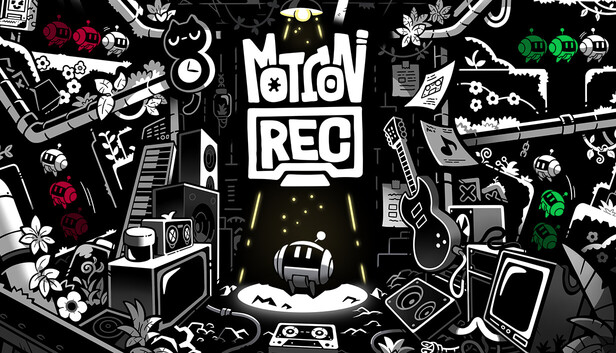
The largely monochrome pixel art makes an immediate impression without surrounding the problem with visual clutter. eShopperReviews praises the presentation but flags the mostly linear progression and limited breathing room between puzzles [7]. The simplicity is useful for reading a space, although it also leaves fewer distractions when a solution refuses to arrive. There is not a large open world waiting to let you postpone the awkward room until you have developed a more cooperative brain.
The narrative is similarly spare, and reactions differ. Final Weapon wanted more distinctive storytelling and music [5], while Loot Level Chill found the ending unexpectedly affecting [4]. That disagreement captures a useful distinction in indie game reviews: an affecting ending and a consistently strong story are different claims. The clear reason to come is the puzzle design. Any attachment to Rec and the ruined surroundings is an additional benefit, not a substitute for enjoying the recording mechanic. A small robot can be charming without needing to deliver a lengthy speech about civilisation.
A clever idea with enough room to grow
MotionRec suits players who like a game to teach a rule, then steadily reveal implications they had not considered. Buried Treasure describes basic recording techniques becoming intuitive before the later challenges push them further [6]. That learning process is the strongest argument for the game: what initially sounds awkward can become a normal part of navigating. The goal is not to memorise one impressive trick but to become comfortable constructing solutions from the surroundings. Understanding the answer is more rewarding than borrowing it.
The recommendation is strong for thoughtful platformer fans, with a straightforward caveat for anyone seeking a relaxed sightseeing trip or a story-led adventure. You will need to enjoy stopping, reconsidering and trying again, and the directed progression means a difficult puzzle can occupy the whole evening’s attention. In return, the core ability offers an unusually clear relationship between observation and action. Come for the moment when an ordinary platform suddenly looks like a recording opportunity. Stay for the increasingly elaborate ways of persuading gravity that the paperwork was completed somewhere else.
Sources
Source links correspond to the numbered references in this review.
[1] PLAYISM: MotionRec official release dates, developer, genre and player count • [2] Steam: MotionRec official credits, mechanics and Windows requirements • [3] Siliconera: MotionRec review — Jenni Lada • [4] Loot Level Chill: MotionRec review — Lyle Pendle • [5] Final Weapon: MotionRec review — Saras Rajpal • [6] Buried Treasure: MotionRec review • [7] eShopperReviews: MotionRec Nintendo Switch review