Quick Review
Monster Train 2 combines deckbuilding with three-floor defence, making placement as important as the cards in your hand. Clan pairings, equipment and room effects create satisfying opportunities for ordinary pieces to become outrageous combinations. Dense information and punishing boss counters demand patience, while the extra dialogue will not improve every run. It is an excellent fit for players who enjoy repeated tactical experiments and learning detailed systems, rather than a light card diversion.
In this review
Reasons to look closer · The upstairs problem is already downstairs · Two clans walk into a railway carriage · The carriage is part of the build · More reasons to return, not all equally persuasive · Verdict: bring curiosity and read the small print · Sources
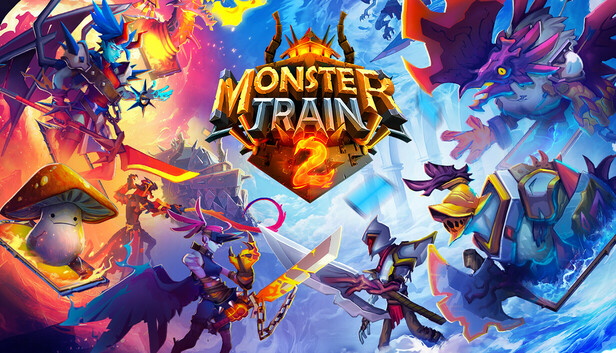
Heaven has a Titan problem, Hell has a train, and apparently that is enough to form a coalition government. Monster Train 2 sends angels and demons into battle aboard a locomotive whose most important passenger is a vulnerable magical fire. Protecting it means recruiting monsters, building a deck and deciding which floor gets the horrifying thing with the useful numbers. Anyone hoping for a quiet carriage should make alternative arrangements. Shiny Shoe's sequel keeps the original's three-level battlefield [2] and gives it plenty of new complications.
Released in full on May 21, 2025 [1], this is a confident expansion of an existing idea rather than a dramatic reinvention. Its appeal lies in how card effects and physical positioning multiply each other's possibilities. The catch is the same multiplication happening inside your head: more choices also mean more rules competing for attention. For a player who enjoys discovering why an apparently modest card completes an outrageous combination, that is a promising sort of trouble.
Reasons to look closer
Look closer if a deckbuilder's best moment, for you, is the instant several ordinary pieces become a very unreasonable machine. Monster Train 2 gives that pleasure a spatial dimension: a good unit still needs the right floor, support and timing. Primary and allied clans let two card pools mingle [4], so choosing a pairing already starts an argument about your plan. It suits repeat experimentation much better than someone seeking a light card diversion with no homework attached.
The upstairs problem is already downstairs
Enemies enter below and surviving attackers climb toward the Pyre. You play units and spells before combat resolves, turning each round into a question of what to kill now and what the next floor can survive later. PC Gamer's Abbie Stone describes that pressure across three simultaneous fronts [3]. It gives the battlefield an unusually useful geography. A problem postponed is still visibly coming upstairs, which is more honest than most problems postponed in real life.
This changes how to judge a powerful card. Raw damage matters, but so does whether it arrives where the dangerous enemy will actually be. Committing everything to one impressive formation can leave another floor looking like an unstaffed reception desk. The attraction is making those interlocking decisions before letting the fight resolve. There is no reflex test to distract from an awkward deployment. You get time to think, and then the train delivers a fairly detailed account of your thinking.
Two clans walk into a railway carriage
The primary clan supplies your champion, while the allied clan broadens the cards available for your deck. The five new launch clans give that pairing system some eccentric material. Pyreborne dragons care about wealth; the Banished make positioning and Valor matter; the Underlegion turn fungal growth into military policy. Stone particularly praises the way these mechanics combine [3], while noting that the opening factions are more involved than the original game's introductions. The sequel starts handing out terminology early.
The useful question is whether one clan helps the other do its job, rather than whether both look strong separately. A support card can become the missing piece that makes a whole floor function. Still, a promising combination is not a guarantee. Shacknews' Ozzie Mejia found certain boss effects could brutally counter an otherwise powerful deck [5]. That is a sensible warning against mistaking a spectacular damage number for a complete strategy. Your monsters can be very impressive and still have a blind spot.
The carriage is part of the build
Room cards give floors their own effects, while equipment attaches bonuses to units. Those additions make the train itself part of your build rather than a convenient shelf for creatures. The official overview distinguishes those two card types [2], and that distinction matters: improving a room rewards a deployment plan; improving a unit rewards what that particular creature contributes. A new card therefore asks several questions beyond whether its printed numbers are bigger. Where will it work, and what else must be there?
Between fights, route choices ask whether your deck needs upgrades, duplication or removal. Getting rid of an unhelpful card can be more valuable than collecting another exciting possibility. The accumulating effects do have a readability cost. GamesRadar+'s Oscar Taylor-Kent found stacked enemy information cumbersome to inspect [4], even with damage previews assisting decisions. This is worth taking seriously: the pleasure should come from solving the situation, not remembering which tooltip contains the crucial clause. Expect some reading alongside the monster management.
More reasons to return, not all equally persuasive
The Covenant Outpost puts character conversations between runs, and unlockable Pyre Hearts change the rules around your train's core. Story is a more visible companion this time, though PC game reviews disagree about how much it adds. PC Gamer found the extra dialogue intrusive [3]; Shacknews enjoyed the illustrated interludes [5]. The practical distinction is whether you want these monsters to become characters or simply need them to stop chatting and resume their excellent work with arithmetic. The tactical appeal does not require the comedy to land every time.
Daily Challenges supply shared conditions and scoreboards, Dimensional Challenges offer authored rule changes, and Endless Mode lets a successful build keep facing escalating opposition. These are different reasons to revisit the systems [2], not a requirement to enjoy everything equally. Daily rankings add comparison without turning the game into a live multiplayer duel. Since launch, Wurmkin have also returned through a free update [7]; the Railforged clan and Soul Savior mode belong to paid DLC. Keep that distinction in mind when browsing the expanded menu.
Verdict: bring curiosity and read the small print
Monster Train 2 is especially easy to recommend to someone who already likes building combinations but wants position to matter as much as the draw. Its additions give an established format fresh decisions without abandoning the shape that made it work. Newcomers can start here, provided they welcome a game that expects them to learn its vocabulary. Depth does not make complexity a requirement: wanting fewer card keywords is a perfectly reasonable preference, not evidence that you have somehow failed the entrance exam for card games.
The reservations are specific: dense information, occasional nasty counters and a story layer that will not improve everyone's evening. None cancels the central strength. Monsters, equipment and rooms create plans with enough moving parts to reward another attempt, especially when the previous attempt revealed one embarrassing omission. This train offers plenty of opportunities to be clever. It also allows the enemy to notice that the clever person forgot to defend the stairs.
Sources
Source links correspond to the numbered references in this review.
[1] Steam — official release, developer, publisher, genre, features and system requirements • [2] Big Fan Games — official game overview and released console platforms • [3] PC Gamer — Abbie Stone, Monster Train 2 review • [4] GamesRadar+ — Oscar Taylor-Kent, Monster Train 2 review • [5] Shacknews — Ozzie Mejia, Monster Train 2 review • [6] Official Steam announcement — native Mac release, December 10, 2025 • [7] Shiny Shoe — released DLC and separate free Wurmkin update • [8] Nintendo — native Switch edition, player count, date and store publisher