Quick Review
Is This Seat Taken? turns conflicting passenger preferences into friendly spatial puzzles, asking you to move little shapes until everyone can share the space. Clear feedback and an absence of timers make experimenting pleasantly unhurried, with imperfect solutions allowing progress. Repetition becomes more noticeable in long sessions, and the light story offers little extra pull. It is an appealing short-break game for anyone who enjoys making a small, awkward arrangement finally behave.
In this review
Reasons to look closer · The noisy one cannot sit next to the sleepy one · Happy enough is different from everybody happy · A rhombus has places to be · Small sittings suit this seating plan · Leave a seat open for your next break · Sources
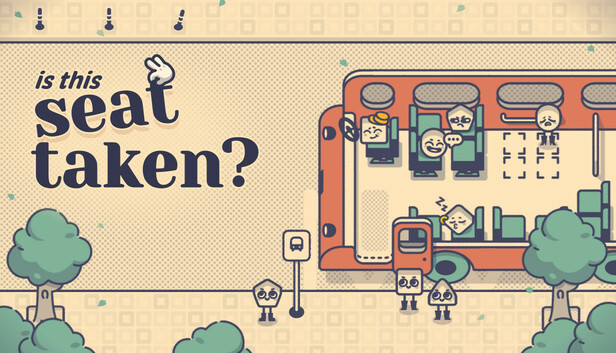
Someone wants a window. Someone wants a friend. Someone appears to have bathed in cologne, which is now everybody else's problem. Is This Seat Taken? turns the tiny negotiations of shared spaces into a logic puzzle, replacing actual passengers with cheerful little shapes. Poti Poti Studio's game released on August 7, 2025 [1], and its premise needs almost no explanation: arrange the available people so their requirements stop colliding. The PS5 edition followed in August 2026 [8]. It is customer service with the blessed ability to pick the customer up and move them.
That immediate familiarity is its strongest invitation. The interesting work comes from satisfying several sensible demands inside an inconveniently small space. This is a modest, friendly game rather than an endless puzzle institution, and that distinction matters. Its charm has room to breathe when you want a little arranging; asking it to occupy an entire weekend risks turning a pleasant commute into a very long replacement bus service.
Reasons to look closer
The absence of timers and leaderboards [4] makes the act of thinking pleasantly unhurried. You can examine who wants what, shuffle a few seats and reconsider without a countdown judging your competence. There is also something unusually kind about a puzzle built around accommodating people instead of defeating them. Even the difficult passenger is a problem to solve, not a villain to eliminate. The appeal is gentle organisation with enough conflicting needs to make a correct arrangement feel earned, rather than a reflex test wearing a cardigan.
The noisy one cannot sit next to the sleepy one
The best complications make familiar environments behave differently. A bus can bring new passengers aboard after others leave, forcing you to reconsider an arrangement that was previously fine. A boat introduces different priorities from a cinema. GamesRadar+'s review highlights the changing situations and readable feedback [5], including indicators for the reach of noise and smells. That visibility matters: a spatial puzzle becomes far less agreeable when the important rule is hiding in a tiny corner, quietly ruining your afternoon.
Dragging a character into place therefore serves two purposes: proposing a solution and checking its consequences. The design encourages you to look at relationships between seats, not simply match one label to one chair. A person who seems easy to accommodate can occupy the only spot that solves somebody else's awkward demand. There is satisfaction in recognising that dependency before rearranging the whole group. It is the difference between a seating plan and moving three people because Dave has suddenly remembered that he hates air conditioning.
Happy enough is different from everybody happy
You do not always need a perfectly content crowd to move forward. Pocket Gamer describes a completion system that permits imperfect solutions [6], while satisfying everyone earns the full reward and opens a city's bonus stages. That creates a useful separation between progressing and polishing. A player who wants another scenario can accept a few disgruntled shapes; a completionist can remain until every small grievance has been professionally neutralised. The game provides the objectives. Your internal wedding planner supplies the pressure.
That flexibility should not be mistaken for a promise that every puzzle will effortlessly click. Pocket Gamer's launch review found the lack of hints frustrating when arrangements became harder to untangle. The important distinction is between being allowed to experiment and being helped to understand a mistake. One removes punishment; the other provides direction. If your preferred cosy game always offers a gentle nudge, the launch criticism is worth knowing. Patience still has a job here, even if nobody has issued it a uniform.
A rhombus has places to be
Nat provides the journey connecting these different venues. An aspiring actor sees a shape like them on screen and sets out to meet their inspiration, a premise detailed in Nintendo's official game description [2]. It is a neat thematic companion to the seating: finding somewhere to belong becomes both the story's concern and the thing your hands are doing. There is no need for an ancient chair prophecy.
Still, the story is best treated as a light connecting thread, not the main course. Pocket Gamer found its conversations forgettable. The game's strongest characterisation often comes from a practical preference: what somebody needs, what annoys them and how that affects the people nearby. Those tiny demands can make anonymous shapes recognisable without requiring a long biography. Anyone shopping for a rich narrative should temper expectations; anyone pleased by a little warmth between puzzles has a better reason to pull up a seat.
Small sittings suit this seating plan
Nintendo Life found the game particularly comfortable in short sessions [7], while noting that longer stretches exposed repetition. That is a sensible dividing line for its audience. A new arrangement can be a pleasant little mental reset after something busier. Several similar arrangements back to back put more weight on the novelty of each rule, and there is only so much surprise available from deciding who may sit beside whom. The theme is delightful; it does not magically exempt the underlying activity from familiarity.
The uncluttered shapes help the practical side as much as the cute side. Reading a small crowd should be easy when the entire puzzle depends on understanding individuals. Nintendo Life also praised the smooth cursor controls and handheld touch option. These are useful strengths for a game built around repeated adjustments rather than dramatic set pieces. Nobody needs a cinematic camera orbit around a successfully seated triangle. Clear information and agreeable movement are the production values that earn their keep here.
Leave a seat open for your next break
The game has also received useful housekeeping since launch. Its Apple version history records per-puzzle saving and adjusted touch placement in November 2025 [3], followed by a saving fix in January 2026. That is relevant to a game whose natural home is the spare moment: stopping halfway should not turn leisure into an appointment you have to finish. Those are documented updates, not a guarantee that every device or version will behave identically; launch-era complaints in video game reviews about saving need that later context.
Is This Seat Taken? is an appealing choice for players who enjoy arranging small systems until the friction disappears. Expect a compact outing, a lightweight story and some repetition rather than endless reinvention. The right audience will find a friendly reason to spend another break with a bus full of fussy geometry. Just remember that finishing with absolutely everyone happy is a game objective, not a reasonable standard for your real commute.
Sources
Source links correspond to the numbered references in this review.
[1] Steam — official release, developer, PC publisher, platforms and single-player listing • [2] Nintendo — official Switch release, publisher, story and compatibility information • [3] Apple App Store — official mobile listing and version history • [4] Google Play — official Android listing, puzzle description and single-player mode • [5] GamesRadar+ — Is This Seat Taken? review • [6] Pocket Gamer — Is This Seat Taken? review, Jack Brassell • [7] Nintendo Life — Is This Seat Taken? review, Jim Norman • [8] PlayStation Store — official PS5 release date, publisher and single-player listing