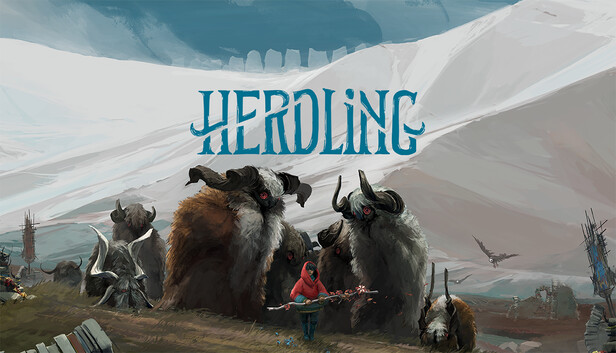
Quick Review
Herdling makes guiding a group of furry Calicorns through changing landscapes an act of care. Naming companions, pausing at camps and finally letting the herd run give the quiet journey an appealing emotional rhythm. Steering can be fiddly, puzzles stay light and animal danger makes it less carefree than it looks, though an immortality option helps. It is best for patient players who value companionship and atmosphere over precise controls or extensive wilderness exploration.
In this review
Reasons to look closer · Steering from behind changes the whole job · A name makes the next obstacle personal · The scenery has teeth in a few places · Open ground gives the adventure room to breathe · A touching trek, not a complicated wilderness simulator · Sources
Herdling turns a mountain expedition into a moving group project in which most participants have horns, magnificent coats and absolutely no interest in your route-planning credentials. Okomotive’s adventure launched in full on August 21, 2025 [1], asking you to guide a growing herd of Calicorns through an often beautiful, sometimes dangerous landscape. The objective is easy to understand: get these creatures somewhere better, preferably without discovering which of them has the least sensible relationship with a cliff.
It is a lovely premise because movement becomes care. Going somewhere is not enough; you need to think about the companions coming with you. That gives a gentle journey something more substantial than attractive scenery to lean on, even though the puzzles and route remain relatively simple. The main question is whether tending a slightly unwieldy group sounds absorbing or irritating. Herdling makes a strong emotional case for the former, but it cannot promise that responsibility will always steer neatly around a corner.
Reasons to look closer
The appeal is an expedition built around protection rather than conquest. Light environmental puzzles, stampedes and a wordless story [2] give the herd different situations to navigate without turning the journey into a sprawling management game. The animals are companions, not production units, and looking after them changes the meaning of a dangerous path. If you like atmospheric adventures with a clear emotional purpose, that is a good reason to investigate. Just do not mistake soft fur and appealing scenery for a guarantee that nothing upsetting can happen.
Steering from behind changes the whole job
Guiding the herd depends on your position behind it. Move around the group and you influence its direction, while commands let you adjust the pace or bring everyone to a halt. Nintendo Life found that straightforward idea less predictable in practice [3], particularly as the animals’ bulk complicated navigation. This is not controlling one neatly bounded character. It is encouraging several large bodies to agree on a plan, a task familiar to anyone who has ever organised a family photograph.
That makes patience part of the interaction rather than something reserved for a difficult puzzle. Slowing down and repositioning can be more useful than repeatedly demanding progress. The trade-off is that a narrow passage may feel fiddly instead of meaningfully challenging. Some awkwardness fits the fantasy of shepherding, but a believable responsibility and an enjoyable control problem are not automatically the same thing. Expect the pleasure to come from bringing the group through together, not from the precision of a character snapping instantly to your intentions.
A name makes the next obstacle personal
The Calicorns are not just an expanding crowd. You can name them, and their different appearances give the herd recognisable faces. TechRadar highlights the camp interactions [6], including animals seeking attention or wanting to play. These quieter stretches are important because affection needs something to attach to. A creature with an identifiable face and a small habit is more memorable than a number beside a generic animal icon, however efficiently that icon could be arranged into a spreadsheet.
The care is modest rather than a deep animal-simulation system. That restraint keeps the trip focused, but it also means the bond depends partly on what you bring to those simple interactions. Players who readily become attached to fictional creatures have plenty of material here; those looking for complex behavioural personalities should keep their expectations smaller. The game is inviting you to notice and care, not asking you to maintain an elaborate husbandry dashboard. That uncomplicated affection fits a journey that keeps moving.
The scenery has teeth in a few places
The journey includes hazards such as unstable ice, narrow crossings and predatory birds. GameSpot describes the tension of choosing between careful movement and a fast escape [4], with injured animals needing attention and healing food. The possibility of losing a Calicorn changes the tone immediately. An awkward turn is no longer just an untidy bit of navigation when it threatens a companion. The game does not need a complicated combat system to give a stretch of terrain emotional weight.
Animal deaths deserve a clear warning, especially for anyone arriving specifically to unwind with animals. Calicorns can die, although the settings include a Calicorn Immortality option [5] to prevent those deaths. Using it is a sensible choice if protection without that particular consequence sounds more enjoyable. The risk can make the journey more affecting, but nobody needs to pass an imaginary shepherding exam before being allowed to appreciate the mountains. Pick the arrangement that lets the companionship work for you, rather than one that turns every ledge into an evening-ruining negotiation.
Open ground gives the adventure room to breathe
The contrast between confinement and freedom is central to the trip. Forests, snow and mountain paths ask for different kinds of attention, while open stretches let the herd move with a different energy. Okomotive frames these stampedes as a central feature [1], and the idea makes sense: after keeping everybody together through an obstacle, simply having room to run becomes its own reward. A broad patch of ground can feel generous when you have spent the previous passage worrying about several furry turning circles.
The music helps make that release expressive. GameSpot praises how the score responds to the herd’s pace [4], making a rush across open country feel different from a cautious approach. That connection is more useful than a pleasant soundtrack merely playing behind the action. It gives the movement a mood and lets a familiar command produce a small emotional payoff. The journey is still directed rather than a huge wilderness to explore, but careful presentation can make a limited route feel like a meaningful distance travelled.
A touching trek, not a complicated wilderness simulator
Herdling is less interested in explaining every detail than in leaving you with a feeling. That approach has limits: PC Gamer admired the adventure but wanted its ending to draw the narrative threads together more decisively [5]. It is worth keeping in mind if mysterious scenery usually makes you expect a thorough final explanation. Wordless storytelling can be expressive without being explicit, but an evocative destination and a satisfying answer are not necessarily the same thing. The emotional journey matters more than a neatly filed account of the world.
A practical warning for Switch 2 owners: Nintendo currently marks the Switch edition’s compatibility unsupported because of progression problems [8]. Check that compatibility status before applying a recommendation for the original Switch edition to the newer system. The strongest recommendation is for players who enjoy quiet adventures, animal companionship and a clear task carried through changing scenery. The reservation is for those who need demanding puzzles, extensive exploration or consistently crisp movement to stay engaged. Herdling has a distinct purpose and an appealingly unusual way of pursuing it, even when the steering threatens to turn a heartfelt expedition into a slow furniture-removal operation. Come for the group, the landscape and the relief of reaching safer ground. Give yourself permission to walk slowly. Your companions are large, and they have brought no maps.
Sources
Source links correspond to the numbered references in this review.
[1] Herdling official press kit: release, developer, genre, platforms and player count • [2] Steam: Herdling official credits, description and Windows requirements • [3] Nintendo Life: Herdling review — Craig Reid • [4] GameSpot: Herdling review — Mark Delaney • [5] PC Gamer: Herdling review — Andy Chalk • [6] TechRadar: Herdling review — Josephine Watson • [7] Panic: Herdling official supported-platform and release overview • [8] Nintendo — current Herdling Switch 2 compatibility warning