Quick Review
Fretless mixes turn-based planning with timed performance, letting you assemble riff sequences and then play them for stronger attacks and defence. Instruments change both your build and the sound of battle, giving the musical theme real substance. Uneven explanations and a demanding status-effect chain can muddy the tactics, while the story and route are fairly conventional. It suits players wanting a manageable, cheerful RPG with active combat and an impressive commitment to guitar jokes.
In this review
Reasons to look closer · Build the setlist, then remember to play it · The instrument is a build choice, not a cosmetic skin · Status effects have joined the pedal chain · A musical world needs more than a loud soundtrack · The verdict: a good short gig, with some awkward tuning · Sources
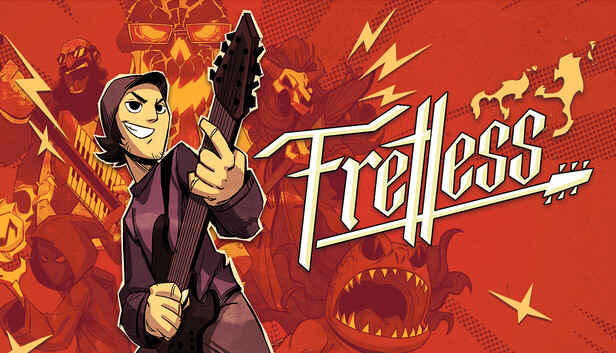
An evil record label promising fame in exchange for your soul is not exactly hiding the warning signs. Fretless - The Wrath of Riffson makes that arrangement literal, then sends a friendly musician into battle with a guitar. Rob wants to reach the Battle of the Bands; Rick Riffson’s Super Metal Records has considerably less wholesome plans. The turn-based setup mixes collectible riffs, musical equipment and timed inputs [7], turning the standard RPG weapon cupboard into somewhere a touring band would lose several expensive cables.
Ritual Studios released the full adventure on July 17, 2025 [2], with a world inspired by musician Rob Scallon and his friends [3]. The musical identity is more than a pun laid over ordinary combat. Your instrument influences how you fight and what you hear, while arranging a turn becomes its own miniature composition. That is the main attraction. The story supplies a cheerful reason to travel, but the interesting decisions concern what goes into the next attack, not the long-term governance of the villain’s recording empire.
Reasons to look closer
Look closer if you like turn-based combat that keeps your hands involved after choosing an action. Fretless offers preparation and performance: assemble useful riffs, pick a sequence, then land the timing inputs that help it work. Expect charming musical creatures, tinkering with gear and some uneven explanations. You do not need to know Rob Scallon’s work, but an affection for extremely committed music jokes will certainly help.
Build the setlist, then remember to play it
Combat begins with a selection from your equipped riffs, and you arrange up to three before hitting Shred. Rectify Gaming describes the instrument-specific riff books [5] as decks, with the available hand shaping each turn. You cannot simply press the favourite attack button forever and assume it will always be sitting there. Choosing which riffs belong together matters, because a damage move, a defensive effect and a setup action are doing different jobs within the same short sequence.
Timing adds a second layer once the sequence starts. Correct inputs strengthen attacks and reduce incoming damage, so defending is not just watching the enemy finish its paperwork. The Crescendo attacks [1] push that musical interaction further, turning a charged special move into a more explicit rhythm sequence. The appeal is the connection between planning and execution: a useful arrangement still benefits from being played well. It also means this is not an entirely hands-off menu RPG.
The instrument is a build choice, not a cosmetic skin
Changing equipment can alter more than attack strength. Acoustic guitar, bass and synthesizer suggest different approaches, while instrument modifications and riff combinations [1] support choices such as heavy damage, life-stealing or effect-focused setups. Customising bridges and strings belongs naturally in a game about musicians, rather than feeling like a generic armour system with the nouns swapped. It makes discovering another instrument potentially interesting even when your current one already looks perfectly capable of upsetting the nearest executive.
The complication is learning what a new setup actually wants from you. Blogcritics wanted clearer introductions to the instruments [6] and more freedom to mix their abilities during combat. A player who understands one dependable arrangement may not see a reason to rebuild it. Fretless has enough individuality in its equipment to encourage experimentation, but the explanations do not always provide the same encouragement. Even a magical guitar benefits from a comprehensible instruction leaflet.
Status effects have joined the pedal chain
The Status FX system is one of the more distinctive ideas. Instead of simply removing an unwanted effect with a standard cure, you shift effects along a chain by applying new ones. Hey Poor Player describes how that system changes the handling of buffs and debuffs [4]. It gives the order of effects practical significance: applying something helpful can also move something harmful toward the exit. The extra complexity makes the effects more distinct, but demands mental bookkeeping.
It can also become a bottleneck. The same review found the later fights’ accumulation of negative effects frustrating, especially when the terminology was difficult to look up again. That is a useful warning about where the challenge comes from. A friendly pixel-art adventure can still ask you to understand a fairly particular ruleset, and missing that understanding is different from missing a timing prompt. Its success depends on whether you enjoy managing those interactions, rather than merely tolerating them until the next guitar flourish.
A musical world needs more than a loud soundtrack
The setting follows through on the premise. Klei’s official description centres the instrument-monster hybrids and musical world [3], while Rectify Gaming noted touches such as scenery producing sounds as you move through it. Battles also change their musical character with the equipped instrument. That is a particularly good connection between systems and presentation: a new setup has an audible identity as well as different numbers. The game is much easier to believe in when its surroundings participate, rather than leaving every musical idea trapped inside the combat interface.
The adventure surrounding those details is more conventional. Blogcritics praised the presentation but found the story thin and the route repetitive [6]. Moving through regions, fighting enemies and collecting improvements gives the game a clear shape, but not much narrative surprise. The villains are broad, the jokes are plentiful, and the music theme does much of the work of holding everything together. That can be enough for a short, good-natured trip. It is less persuasive if you want the plot to become as intricate as the equipment menu.
The verdict: a good short gig, with some awkward tuning
Fretless is strongest when it makes musical decisions into useful combat decisions, rather than merely renaming familiar RPG concepts. There are also optional bosses, pedals and upgrades to reward curiosity beyond the direct route, as Rectify Gaming’s review explains [5]. Launch-era PC game reviews should not be treated as immutable verdicts, either: the official update history includes later readability improvements and specific battle and progression fixes [2]. Those changes are welcome, although they do not by themselves prove every reported issue is gone or make the underlying adventure more expansive.
The recommendation is for players who want a distinctive, manageable RPG with active combat and plenty of musical personality. For anyone seeking a deep story, a sprawling exploration game or a perfectly explained tactical system, it is less convincing. Still, the central combination is appealing: compose a useful turn, perform it, then adjust the next one. The record deal is obviously suspicious. The guitar-based solution to that problem is considerably easier to recommend.
Sources
Source links correspond to the numbered references in this review.
[1] Steam — official current publisher, developer, genres, single-player mode and mechanics • [2] Ritual Studios official Steam announcements — full release and subsequent updates • [3] Klei — official Fretless game page, premise and developer • [4] Hey Poor Player — full PC review, July 17, 2025 • [5] Rectify Gaming — Michael Merchant’s full review, August 5, 2025 • [6] Blogcritics — Michael Prince’s full review, July 17, 2025 • [7] Playdigious Originals — official original-publisher game description and combat features • [8] Klei homepage — explicit confirmation of current Klei Publishing role