Docked Review
Quick Review
Docked makes cargo handling a matter of alignment, clearance and restraint, with machinery that asks you to learn its particular procedures. Contracts give rebuilding a port purpose, while Free Play preserves useful work without deadlines or economic pressure. The appeal is careful operation, not instant automation, and physics or handling friction deserves attention. It suits patient simulation fans who find small improvements in a practical job rewarding, rather than anyone hoping the containers will organise themselves.
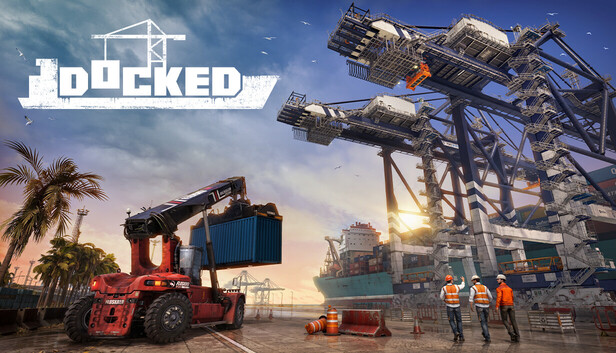
Docked makes a persuasive case for leaving the world saving to somebody else: there are containers to shift. Saber Interactive's port simulator launched on March 5, 2026, putting you to work rebuilding Port Wake and the family business. Contracts fund new machinery and infrastructure. The attraction is practical responsibility, not simply collecting enormous vehicles and parking them somewhere photogenic.
Learning the machinery, not just collecting it
The developer's machinery guide makes the difference clear. A Reach Stacker needs a centered approach to grip a container; carrying its load low helps avoid tipping. That turns an apparently simple pickup into a question of alignment, clearance and restraint. The impatient solution is not necessarily the useful one. On the Straddle Carrier, the cab can face forward for travel or rotate across the yard for a better view of the spreader. Even choosing where to look becomes part of operating the machine rather than a camera adjustment you make once and forget.
The cranes push that idea further. Saber describes countering a swinging spreader by stopping early, then moving the cabin to meet it. Corner flippers help guide the spreader onto the container. These details suggest a simulator interested in the awkward interval between arriving near something and actually securing it. The distinction will appeal to people who enjoy learning a procedure. Anyone hoping to press one button and watch a mountain of cargo politely organize itself should adjust expectations; apparently the mountain has paperwork.
Free Play keeps the job and drops the deadline
The May Free Play update offers a less hurried way to engage with that work. Available immediately, it removes mission objectives, time pressure and economic constraints while retaining cargo plans linking ship, yard and train. Its initial equipment list contains five machines, not every vehicle in the game. A handheld tablet manages the plan and adjusts time and weather, and progress can be saved partway through. Finishing a plan lets you generate another. That is a useful distinction from merely wandering an empty port: the mode preserves a job to do without making a deadline the reason to do it. Earlier updates also made campaign jobs replayable after their associated milestones and made minigames optional, with extra rewards for completing them. Together, those changes give players more control over which parts of the working day they repeat. They do not establish that the promised future AI workers have arrived. The currently documented appeal is operating the equipment yourself, with fewer demands attached, rather than delegating everything and retiring to an imaginary executive biscuit drawer. Free Play removes deadlines; it is neither an empty sandbox nor the still-promised AI workforce.
Paid equipment and practical maintenance
Later additions need a separate label on the manifest. July's Contraband content belongs to the paid expansion, not the base game's standard equipment allowance. It adds a Forklift for tight spaces and pallet handling, plus a scanner used to compare container contents against the manifest and flag illegal goods. Twelve jobs and another campaign mission accompany that equipment. This changes the kind of attention being asked for: the question becomes whether the cargo should leave, not just whether you can move it. It is an interesting extension of the premise, but it should not become a reason to credit the original purchase with features sold separately. The Forklift is explicitly exclusive to that DLC. For someone chiefly interested in containers and cranes, the existing operations remain the relevant starting point; the inspection work is a distinct paid extra, not compulsory homework.
There are also practical reasons to distinguish design ambition from demonstrated reliability. August's maintenance notes report fixes for forklift forks passing through cargo or falling off, duplicate contracts and several camera or visual problems. They add recovery options for a tipped forklift and misaligned pallet cargo, and extend the Logistics challenge from seventeen to thirty minutes. Recovery tools are a welcome kind of realism compromise: a mistake need not become an entire evening's administrative disaster. Those notes establish specific changes, not flawless physics or a measured performance result. This source based assessment cannot tell you how satisfying a joystick feels or how steadily your machine runs the port. What it can identify is a clear audience: players who find small operational improvements rewarding and want a job simulator willing to let them work more slowly. Docked's strongest pitch is careful handling, not spectacle. Treat the cargo with respect; it is already having a difficult day. Measured controls and performance evidence is needed to answer those remaining practical questions; patch notes alone cannot.
PlatformsSteamLaunchDemoMachinesReplayChoiceFreeplayExpansionMaintenance