Quick Review
Discounty makes running a supermarket satisfying through connected problems: shelves need stock, queues need attention and tomorrow's layout can solve today's bottleneck. Its shopkeeping loop is the strength, with a sharp-edged town and expanded community choices giving growth context. Fiddly checkout work, repeated errands and abrasive neighbours may grate. Players who enjoy improving a practical routine should find a rewarding shift here, but those seeking constant novelty or a generous romance system should look elsewhere.
In this review
Reasons to look closer · The shop floor is a surprisingly good puzzle · Growth is more interesting when space gets awkward · Blomkest is a neighbourhood, not a universal fan club · People or Profit? changes the conversation · Verdict: A rewarding shift, provided you like the job · Sources
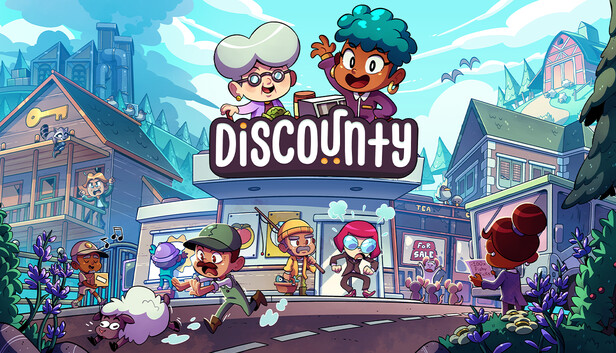
Discounty offers the classic small-town fresh start, except the welcoming family member immediately puts you on the checkout. Your aunt’s supermarket in Blomkest needs stock, customers and someone willing to mop up after both. Crinkle Cut Games’ management sim fully released on August 21, 2025 [1]. Its appealing trick is making shop work feel purposeful: today’s awkward layout becomes tomorrow’s improvement, and a successful shift buys the means to handle an even less sensible quantity of groceries.
The catch is that expansion is not automatically good news for everyone outside your front door. Blomkest has its own history, businesses and resentments, and your aunt’s ambition is not exactly a community gardening initiative. Discounty combines comfortable routines with a less comfortable question about who benefits from growth. The shopkeeping is the clearest attraction; the surrounding drama is more uneven. Importantly, its substantial free People or Profit? expansion means the current game has more to offer than its original ending and launch reviews might suggest.
Reasons to look closer
This is worth considering if you enjoy spotting a bottleneck, changing a layout and seeing the next day run more smoothly. Stocking, selling and reorganising form a satisfying practical loop, while the town gives your business a setting with more personality than a generic profit chart. It is not a complete replacement for a sprawling social life sim. The emphasis stays on the shop, and its supposedly cosy atmosphere leaves room for impatience, awkward people and the discovery that your employer is also your aunt.
The shop floor is a surprisingly good puzzle
Shelves, stock, cleaning and prompt service [2] compete for attention once the doors open. The interesting part is that these are connected problems. A badly arranged store creates unnecessary movement; that movement takes time away from customers; an empty shelf makes yesterday’s good sales feel considerably less impressive. Improvement becomes something visible rather than an abstract percentage. Moving a fixture can be a meaningful decision. This is the rare fantasy world where relocating the cleaning supplies qualifies as a small personal breakthrough.
The early checkout asks you to total purchases, while upgrades can remove some of that manual work. Nintendo Life’s Ken Talbot found the till interface fiddly but enjoyed the broader cycle of expanding and improving the store [5]. It is a useful distinction for a management sim: repetition can become satisfying when there is a clear route to doing it better. It becomes less appealing when handling the controls takes attention away from managing the actual problem. A queue should test your organisation, not your patience with a calculator.
Growth is more interesting when space gets awkward
Trade agreements bring local goods into the shop, while profits fund expansion and advertising [1]. The reward is not merely a bigger balance. More products and more demand change what the existing layout must accommodate. That gives progression a physical consequence: a comfortable arrangement can become inefficient as the business grows. There is a pleasant little cycle of diagnosis and revision here, provided rearranging shelves sounds like a reward rather than an unusually specific punishment for forgetting to do the washing-up.
The game is strongest when your next improvement answers something that happened during the previous shift. GameSpot’s Jordan Ramée praised that recurring process of spotting weaknesses and investing in solutions [6]. It makes an incremental upgrade feel earned through observation, not simply purchased because the next button lit up. The obvious trade-off is workload. More successful trading creates more things to maintain, so growth does not automatically mean rest. Congratulations on your flourishing business; there is now substantially more floor to mop.
Blomkest is a neighbourhood, not a universal fan club
The publisher introduces Blomkest as a harbour town whose residents may object to your expansion [3]. That gives the premise more friction than a procession of grateful customers. Suppliers have concerns, local relationships complicate business and your aunt’s priorities do not necessarily align with everyone else’s. The tension is a worthwhile choice for this setting. A supermarket does not exist in a vacuum, even if a beautifully organised storeroom can briefly persuade its manager that the rest of society is an unnecessary complication.
Whether the residents are entertaining company is more divisive. Talbot enjoyed the town’s comic vignettes, while TheSixthAxis’s Gareth Chadwick found its unpleasant personalities and repeated errands wearing [7]. Neither response requires a bug to explain it. A slightly abrasive town can provide satire and conflict; it can also feel like a room full of people interrupting the activity you bought the game for. Expect a shop-centred story with sharp edges, not an uninterrupted stream of supportive neighbours arriving to congratulate your freezer placement.
People or Profit? changes the conversation
Launch-era assessments need a substantial qualification here. GameSpot found the original story’s moral consequences muddled, but the free People or Profit? expansion adds a fourth chapter and three new endings [4]. PQube confirmed availability across the original platforms in August 2026. It gives the player further decisions about the town after the former conclusion. That does not automatically settle every criticism of the writing, but it does make the old claim that the story simply stops there an inaccurate description of the current release.
The expansion also adds town restoration, shop gadgets, selectable stock and the ability to buy a house. A self-checkout and online orders extend the business side, while rebuilding local spaces gives activity outside the store a more substantial purpose. These additions fit the existing tension between improving a community and increasing revenue. They also make a useful practical difference to expectations: the trailer is no longer the only possible home, and closing time need not signal that all meaningful work has disappeared behind the supermarket’s locked door.
Verdict: A rewarding shift, provided you like the job
Discounty’s clearest success is turning familiar retail tasks into a readable chain of problems and improvements. Stock levels, layout and service connect well enough that progress can feel like growing competence rather than a number being inflated. The pixel-art town gives that work a recognisable home, and the satire prevents the setting from being entirely frictionless. The expanded version also makes a stronger proposition on paper than the original package, because its additional chapter and activities address specific limitations rather than merely adding another colour of shelving.
The recommendation still depends on your appetite for routine. Choose it for the pleasure of making a modest operation work better, with town drama as a complicated accompaniment. Be more cautious if you need a rich romance system, constant novelty or a community that is always delighted to see you. Its best moments are likely to involve a practical solution to yesterday’s irritating problem. Sometimes that is enough. A clean aisle, stocked shelves and a queue moving at a respectable speed can be an achievement, even before the family business starts another moral argument.
Sources
Source links correspond to the numbered references in this review.
[1] Steam — full release, official metadata, Windows support and core shop systems • [2] PQube — official Discounty overview, shopkeeping features and single-player details • [3] PQube — official launch announcement and original released platforms • [4] PQube — People or Profit? expansion available across original platforms (August 6, 2026) • [5] Nintendo Life — Ken Talbot, Discounty review (August 17, 2025) • [6] GameSpot — Jordan Ramée, Discounty review (August 21, 2025) • [7] TheSixthAxis — Gareth Chadwick, Discounty review (October 2, 2025) • [8] Apple App Store — official iPhone/iPad release, Crinkle Cut Games credit and Snapbreak publishing • [9] Google Play — official released Android port, published by Snapbreak