despelote Review
Quick Review
despelote uses kicking a ball around Quito to explore childhood, community and a country caught up in football excitement. Wandering, overheard conversations and a deliberately remembered-looking neighbourhood give ordinary moments value beyond completing objectives. That freedom asks for patience and self-directed curiosity, with little resemblance to a conventional sports campaign. It is most appealing to players who enjoy personal perspectives and small discoveries, rather than competitive mastery or a constant checklist.
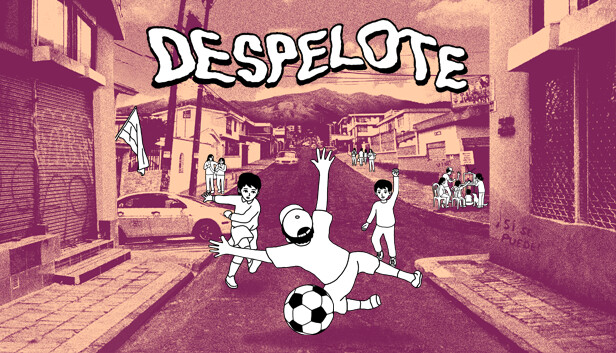
Most football games want you to become a superstar. despelote is more interested in whether you can stop bothering the neighbors. Its main story follows a child in Quito, Ecuador, in 2001, with the country approaching its first World Cup qualification. Kicking a ball around is a way into the community, not an entrance exam on the offside rule. The central attraction is being small in a place where something enormous is happening around you. Anyone looking primarily for a conventional sports campaign should adjust that expectation before taking the first kick.
An afternoon with room to wander
Its approach to direction is particularly interesting. Cordero says that early players liked the world but struggled to understand what they were supposed to do. Conventional objectives would have undermined the freedom he wanted, so the solution was a watch and a deadline for returning home to dinner. Time passing gives the wandering a frame without turning every moment into a task to tick off. That is an appealing distinction: an afternoon can have a destination without requiring a productivity dashboard. It also tells you what kind of attention the game rewards. Experimentation matters more than efficiently following instructions. Players who enjoy making their own small discoveries have a clear reason to be interested; those who need constant goals may find the same freedom less comforting.
A remembered Quito in sights and sounds
The visual design makes its own argument for memory over literal reconstruction. Artist Sebastián Valbuena describes bringing expressive drawn characters into a grittier setting, while Cordero explains how scanning real streets preserves textures difficult to recreate by hand. The locations are assembled rather than mapped exactly: real buildings can become neighbors even when they are not adjacent in Quito. This is a thoughtful compromise between specificity and invention. A place can feel personally observed without pretending to be a navigation app. The grainy surroundings and contrasting cartoon figures also give the project an identity that does not depend on competing with a televised stadium. The sensible question is whether that deliberately stylized presentation appeals to you, not whether it wins a contest for the most individually rendered blades of grass. That difference between remembered place and literal map helps frame the childhood encounters without spoiling them.
Conversations follow a similarly considered philosophy. In an interview with Cordero and sound designer Ian Berman, the developers explain that dialogue began as something Cordero wanted to avoid. Improvised exchanges eventually offered a better way to communicate the place, and the team altered the game around those recordings rather than forcing every conversation into a predetermined slot. Cordero says the park's conversations were not meant to be essential plot instructions. That is a welcome alternative to treating every adult as a vending machine dispensing quest objectives. Overhearing fragments can express a child's position in the world: nearby, curious, but not necessarily in charge. The trade-off is that incidental listening asks for patience. If dialogue only interests you when it immediately unlocks something, this design is deliberately looking elsewhere.
Revisiting the neighborhood
The shipped package has also grown in practical ways. A July 2025 Steam update added scene selection and a freeplay version of the in-game soccer minigame, including local competition with a second controller. Those extras normally unlock after finishing the story; the developer also supplied a title-screen shortcut because the original release had not tracked completion. Scene selection makes revisiting a missed interaction less of a commitment, while freeplay gives the small soccer game a life outside its narrative role. Neither turns the main story into a cooperative campaign. The same update added a sprint-toggle option and listed fixes for stuck balls and progression problems. That is useful maintenance, not grounds for promising perfect performance. Even a childhood recollection benefits from ensuring its ball has not become permanently employed by the goalpost. Two-controller freeplay should not be mistaken for two-player access to the story itself.
Cordero's explanation of the original idea is the best guide to whether despelote belongs on your shortlist. The stadium-focused sports games he knew did not reflect the football he had grown up playing in neighborhoods and parks. He wanted a short narrative game about that other experience. That makes the smaller scale a creative choice rather than a failed attempt at a grand sporting simulation. If your attraction to games includes personal perspectives and ordinary places, there is a persuasive reason to make room for this one. If what you really want is a vast competitive sports package, its priorities point elsewhere. Sometimes the interesting part of football is not becoming the person on television. It is remembering who was standing beside you before anybody turned it on.
PremisePlay designArt designDialogueUpdateOriginsSteamLaunch