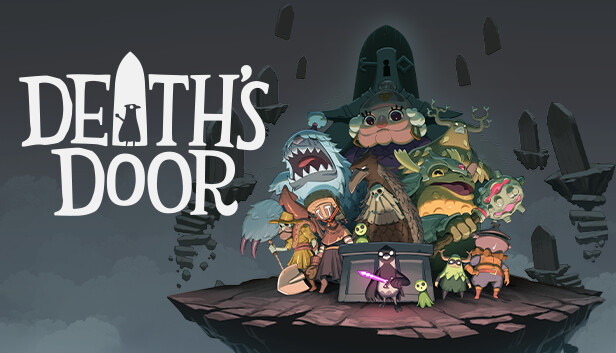
Quick Review
Death's Door pairs precise, readable combat with a strange, melancholy world full of shortcuts and secrets. Its small toolkit rewards learning enemy rhythms, while the soul-collecting crow and afterlife bureaucracy bring warmth and dry humour to the adventure. The lack of a map can make returning after a break frustrating, and fights demand attention. It suits players who enjoy focused action and exploring interconnected spaces, provided they can remember the way home.
Death's Door is an excellent fit for anyone who likes compact action adventures with demanding fights and a world worth poking around. Its little crow has a huge administrative problem, and the game turns that problem into a wonderfully strange journey. The main reservation is navigation: without a map, remembering a route can become harder work than defeating whatever lives at the end of it.
Death clocks in
Most games hand you a destiny. Death's Door hands you a job. You are a crow working for a bureaucracy that collects souls, and a stolen assignment sends you somewhere that death has apparently stopped checking its inbox. It is a great premise because it makes the supernatural feel faintly familiar. Even the afterlife has processes, and someone is definitely going to blame the newest employee.
Acid Nerve balances that dry comedy with genuine melancholy. The creatures refusing to move on are more interesting than a queue of monsters wearing increasingly expensive hats. Their attachment to life gives the journey an emotional shape, while the brief conversations leave space for the environments to speak. Nintendo Life's review particularly praises the supporting cast and the way these small exchanges keep the adventure focused.
That balance matters. A game about death could easily become relentless gloom or a nonstop parade of skeleton jokes. Here, the absurd office framing creates room for both warmth and sadness. The small protagonist also makes the scale work beautifully: a crow with a weapon looks brave before it has accomplished anything. You want the tiny employee to survive this exceptionally unreasonable shift.
A small toolkit with sharp edges
Combat revolves around melee attacks, dodging and ranged abilities rather than an enormous catalogue of equipment. The appeal is readable decision-making. There is something satisfying about a design that asks whether this is a safe moment to attack, instead of whether a spreadsheet says your trousers provide optimal damage. Learning an enemy's rhythm matters more than collecting another page of menu options.
The official Steam description confirms melee weapons, arrows, magic and upgradeable character stats. Those ingredients support a useful blend of direct action and gradual development: you have room to improve your crow, but the game still expects you to improve your judgement. Its cute silhouette should not be confused with a promise of effortless progress. This is an adventure with teeth, even if its hero technically has a beak.
The penalty for failure is comparatively forgiving. Nintendo World Report notes that collected souls remain yours when you die, with the crow returning to the area's door. That distinction makes a difference to the recommendation. Repeating a troublesome encounter can be frustrating enough without attaching a second errand to retrieve your wallet. Death's Door can challenge your execution while avoiding that particular extra layer of punishment.
Exploration provides the other half of the attraction. Routes loop back through shortcuts, and new abilities give previously unreachable places a reason to stay in your memory. Nintendo Life highlights how a single door can become a useful checkpoint for several routes. This is the kind of spatial design that makes a lever feel like a reward. Congratulations: your grand treasure is a much shorter walk.
There is a catch, and it is a meaningful one: no in-game map. GameSpot identifies returning after a break as a particular frustration because you may need to relearn an area's layout. Remembering landmarks can make a world feel tangible, but it also asks something of your schedule. If you play in scattered sessions between other games, this is a stronger warning than it would be for someone settling into a focused weekend adventure.
Healing, platforms and buying advice
Healing also belongs to the world rather than an overflowing backpack. Seeds planted in designated pots create places to recover, a system discussed in Nintendo Life's review. That gives exploration a practical purpose beyond collecting shiny things. It also makes the route itself part of your preparation. The trade-off is that players who prefer freely available healing may find the arrangement restrictive when a difficult stretch is already testing their patience.
Death's Door is a single-player game developed by Acid Nerve and published by Devolver Digital. It originally released on July 20, 2021. The official website lists PC, Xbox One, Xbox Series X/S, PlayStation 4, PlayStation 5 and Nintendo Switch. Steam lists Windows requirements. Compatibility with newer hardware should not be mistaken for a separately released native edition, and platform choice is best guided by the store listing for the device you actually own.
Mobile needs a separate warning. Death's Door previously appeared through Netflix, but Game Informer reported its removal in the July 2025 delisting wave. Do not buy a Netflix subscription expecting access to it. The current official game's website directs buyers to PC and console stores; an old mobile review or download listing is not proof of present availability. On Steam, the Deluxe package adds an artbook and soundtrack, so the standard game is the straightforward choice if you only want the adventure.
Worth taking the shift?
Death's Door earns its recommendation through focus: a memorable setting, a manageable combat vocabulary and interconnected spaces with enough personality to reward attention. Its limitations are equally clear. Map-free exploration can interrupt the momentum, and precise fights will not suit every mood. For players willing to learn both enemy patterns and the way home, though, this is an appealingly strange action adventure. The hours may be dreadful, but the crow deserves employee of the month.
Sources
Official information and review sources supporting this article.
Steam: official game details and editions · Death's Door: official platforms and stores · Nintendo Life: Switch review · GameSpot: combat and navigation review · Nintendo World Report: death and progression · Game Informer: Netflix delisting report