Quick Review
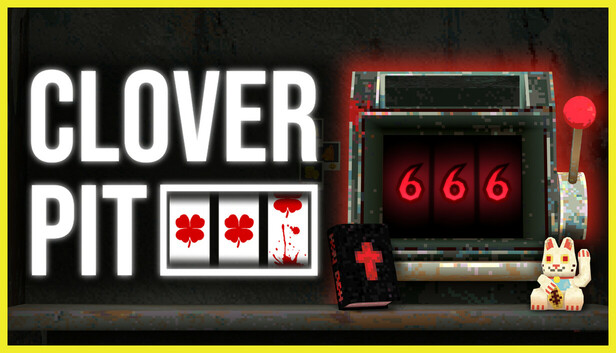
CloverPit traps you with a slot machine and asks you to build charm combinations strong enough to survive escalating fictional debts. Watching modifiers cooperate is the draw, while the grimy room gives score-chasing a memorable horror setting. Opaque early explanations, random upgrade opportunities and limited strategic variety can wear thin. It suits synergy-loving roguelite players, but anyone avoiding simulated gambling imagery or seeking a substantial story should leave this particular room alone.
In this review
Reasons to look closer · The deadline is the real opponent · A collection of charms is not automatically a plan · The room is doing important work · More ways to break the machine, with an important distinction · Verdict: A distinctive little nightmare, not an infinite guarantee · Sources
CloverPit presents a financial arrangement that would raise several concerns during a tenancy inspection. You are trapped in a filthy room with a slot machine, an ATM and a floor that can remove itself when payment is late. Panik Arcade’s roguelite fully released on September 26, 2025 [1]. The challenge is to bend its machine into something capable of meeting escalating demands. These are fictional coins and fictional debts: the machine does not take real-money wagers [9]. The terrible landlord is strictly part of the entertainment.
That distinction matters because CloverPit is not asking you to master an actual casino. It gives you supernatural modifiers, conspicuous loopholes and a system designed to be pushed beyond reasonable behaviour. The attraction is discovering how those pieces combine while the surroundings insist you are having a very bad evening. The reservation is whether that discovery remains interesting after the first successful builds. Its presentation is wonderfully unpleasant; its long-term strategic range is a more contested proposition than the clattering machine wants to admit.
Reasons to look closer
Look closer if you like roguelites built around manipulating rules rather than testing reflexes. CloverPit offers compact decision-making, escalating targets and a strong sense of place, with a machine that becomes much less mysterious once its modifiers start working together. It is less suitable if randomness in upgrade availability annoys you, or if you want a large narrative adventure behind the sinister room. The simulated gambling imagery is central rather than incidental, so anyone avoiding that particular feedback loop should give this one a miss.
The deadline is the real opponent
A deadline gives you three rounds to produce the required total [6]; meet it and the next demand climbs, miss it and the floor offers an extremely direct performance review. That creates a useful distinction between a gratifying spin and a sustainable run. One impressive result is not automatically enough. The important decisions concern how the whole setup will keep producing, not simply whether the next animation ends in a shower of coins. The machine is noisy; the deadline is the part with authority.
The surrounding economy gives those decisions somewhere to go. Earnings can support further improvements or the obligation waiting at the ATM, while bonuses and trade-offs complicate the next stage. That is the actual game beneath the lever-pulling: deciding how to strengthen a fragile system before its requirements outgrow it. The appeal is not financial realism. It is the familiar roguelite pleasure of looking at an apparently unreasonable target and wondering whether your latest assortment of strange objects can make it look embarrassed.
A collection of charms is not automatically a plan
Charms can change symbol frequency, improve multipliers and otherwise reshape the machine’s output [7]. Their relationships matter more than their individual descriptions. A modifier that looks exciting in isolation may contribute little to the direction a run has already taken, while a less theatrical effect can make several other pieces more useful. The satisfying part is assembling a coherent contraption, then watching its parts collaborate. It is essentially an engineering project conducted by someone whose workbench has failed every hygiene inspection.
The catch is that assembling the contraption depends on what appears. In her August 2026 review, GameSpew’s Kim Snaith enjoyed the loop but found the range of convincing charm strategies narrower than its inspirations. Separate the number of available charms from the number of genuinely different strategies they support. A game can contain plenty of objects without making every combination equally promising. CloverPit’s strongest audience is likely to enjoy finding a satisfying interaction for its own sake, rather than requiring every fresh run to reveal a fundamentally different kind of problem.
The room is doing important work
The rusty cell and escape-room atmosphere [3] give familiar number-chasing a grubby physical setting. Instead of an abstract menu between attempts, there is a place that appears actively uninterested in your wellbeing. That helps explain why the premise works better than a plain slot-machine interface would. The threat of failure has a visual home, and the equipment feels like part of the predicament. It is surprising how much personality can come from furnishing one room with several extremely bad ideas.
That hostility also affects the introduction. PC Gamer’s Robin Valentine found the early explanations opaque [6], with important information discovered by inspecting the surroundings. There is an appealing connection between learning the rules and understanding the prison, but mystery can become friction when a new player cannot tell what matters. Expect curiosity to be part of the onboarding. Do not assume the atmosphere promises an elaborate story beyond the central system, either: the strongest reason to stay is still what happens at the machine.
More ways to break the machine, with an important distinction
The base game includes unlockable run modifiers, seeded runs and an Endless Mode [1], giving repeat visits different purposes beyond seeing the first conclusion. These options are valuable when the core activity already appeals; they do not transform its character. If selecting modifiers and pursuing a higher total sound enjoyable, there is room to continue. If the act of watching another set of reels resolve has become tedious, another objective is unlikely to perform a miraculous personality transplant on the machine.
There is also a separate paid expansion. Unholy Fusion arrived in April 2026 [2], adding a Surgery Machine that combines charms and introduces further build options. It should not be confused with the original 2025 release or treated as mandatory equipment for beginning a run. The distinction matters when comparing the original release with the expanded version: the game has received additional content, but purchasing more possibilities is not the same thing as discovering that the underlying rhythm suits you. Decide whether you like the contraption before ordering attachments.
Verdict: A distinctive little nightmare, not an infinite guarantee
CloverPit makes an effective combination out of oppressive scenery and exaggerated systems. It takes the impersonal cruelty of an escalating requirement, puts it in a visibly awful room and lets you fight back with modifiers that would get a real machine confiscated. The resulting attraction is easy to understand. A coherent build turns apparent helplessness into agency, at least temporarily, and the presentation gives that turnaround more character than a clean spreadsheet could. It is a compact idea with a convincing sense of identity.
The recommendation is strongest for players who enjoy experimenting with synergies and can tolerate uneven opportunities between attempts. It is weaker for anyone seeking constant control over outcomes, a deep story payoff or the replay range of the very best roguelites. Neither a lucky result nor a spectacular animation proves there is another hundred hours of discovery waiting. Enjoy it as a strange mechanical puzzle with theatrical stakes, not an obligation to keep pulling forever. Sometimes the sensible victory is leaving the room while its furniture still makes you laugh.
Sources
Source links correspond to the numbered references in this review.
[1] Steam — original release, official credits/genres/mode, base-game features and Windows support • [2] Panik Arcade — official FAQ, fictional gambling mechanics and Unholy Fusion expansion • [3] PlayStation Store — native PS4/PS5 release, horror setting and genres • [4] Nintendo — native Nintendo Switch 2 release on August 13, 2026 • [5] Xbox — native Xbox One/Series X|S release on November 20, 2025 • [6] PC Gamer — Robin Valentine, CloverPit review (October 9, 2025) • [7] GameSpew — Kim Snaith, CloverPit PS5 review (August 13, 2026) • [8] Nintendo — native Nintendo Switch release on August 13, 2026 • [9] Apple App Store — official iPhone/iPad version and no real-money slot wagers • [10] Google Play — official Android version linked by Panik Arcade