Quick Review
Chants of Sennaar makes deciphering unfamiliar languages the heart of an adventure through a divided tower. Watching gestures, testing glyph meanings and revising notebook guesses produces satisfying breakthroughs, especially as different grammars change how you think. Stealth sections and backtracking are less rewarding interruptions to that careful deduction. It is a strong choice for patient, observant players who enjoy uncertainty and discovery, with understanding itself supplying the reward rather than combat or spectacle.
Chants of Sennaar is a lovely recommendation for curious players who enjoy observation, deduction and changing their minds. Its invented languages turn understanding into meaningful progress. Stealth and occasional backtracking are less persuasive, but the central idea is strong enough to make reading a sign feel like a genuine achievement.
Please excuse the confused traveler
Most games let you assume you understand the basic instructions. Chants of Sennaar politely removes that privilege. A sign, a conversation or a simple gesture can be a small mystery, and the first important equipment you need is the willingness to admit you have absolutely no idea what anybody is saying. Finally, a fantasy adventure that captures arriving at the wrong train platform. Rundisc’s single-player puzzle adventure follows a Traveler through a tower populated by divided peoples. Inspired by the myth of Babel, it makes their languages the central challenge. The goal is to restore communication, and that gives the familiar business of exploring rooms and solving mechanisms an unusually generous purpose. Learning is how you help.
A notebook full of useful wrong answers
The basic loop is wonderfully understandable even when the words are not. Observe what people do, compare the symbols around them and suggest meanings in your notebook. Those guesses help you interpret later encounters. A convincing theory may suddenly make a whole exchange readable, or produce nonsense that sends you back to your assumptions. Both outcomes are useful. The notebook eventually presents illustrated pages where you match glyphs to meanings. Correctly completing a page confirms those translations. That structure gives the adventure a safety rail: you can experiment without spending the entire game wondering whether one early misunderstanding has ruined everything. It also gives knowledge a satisfying sense of permanence. There is a small trade-off. Confirmation can make discovery feel a little like filling in a worksheet, particularly when one uncertain entry holds up an otherwise convincing set of answers. Even so, the balance is sensible. A completely unassisted translation simulator would be a different proposition, and probably come with an application form. Chants of Sennaar wants deduction to be approachable without solving the whole mystery for you.
Different languages, different ways of looking
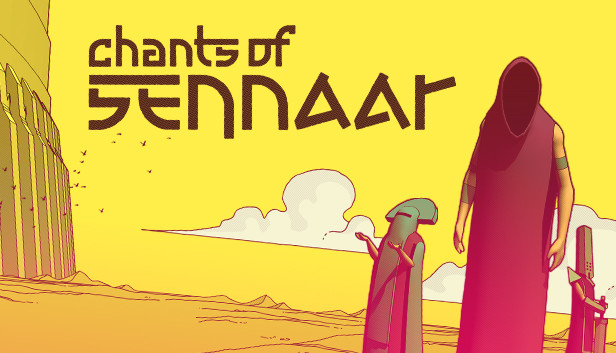
The tower’s languages extend beyond swapping unfamiliar glyphs for familiar words. Grammar and sentence construction differ, so a useful approach in one area may need adjusting in another. Recognizing individual terms is only part of understanding what somebody means. That is the design’s smartest source of variety: it changes the thinking instead of simply increasing the size of the vocabulary list. Those differences also give the communities character. The player has to consider context rather than treat everybody as an interchangeable dispenser of clues. Communication becomes a relationship between what people value, what they express and what an outsider assumes. The story benefits because its central problem is something you actively work through. The colorful architecture and strong comic-book influence support that sense of discovery. Distinct spaces give the tower an identity beyond a collection of locked doors, and body language matters when written language is still opaque. This is a particularly good match between presentation and premise: watching carefully is already part of the puzzle-solving, so the surroundings have a practical job as well as a decorative one.
A few interruptions in the conversation
The conventional adventure puzzles are often familiar mechanisms: switches, objects and environmental arrangements. Their appeal depends heavily on the language surrounding them. Understanding an instruction can be the real breakthrough, with carrying it out providing the payoff. If you want elaborate mechanical puzzles independent of the translation system, that emphasis may feel narrower than expected. Stealth is the less convincing addition. Some sections ask you to avoid guards, use cover or create distractions. These obstacles make sense in a divided world where a stranger cannot stroll everywhere, but they ask for a different kind of attention. Timing a movement past danger offers less of what makes the game special than revising a theory about a misunderstood phrase. Backtracking can also become friction when an interpretation is wrong or a contextual clue has been missed. The best response is often to revisit evidence rather than brute-force notebook combinations, yet retracing a route is not automatically interesting just because the original discovery was. These limitations matter most for players who want a completely relaxed puzzle experience. The attractive art does not guarantee that the tower will always let you proceed at a comfortable pace.
Bring curiosity, leave the walkthrough closed
Chants of Sennaar originally released on September 5, 2023 for PC, PS4, Xbox One and Nintendo Switch, developed by Rundisc and published by Focus Entertainment. Playdigious later brought it to iOS and Android on August 26, 2025. The mobile release is a separate port, with a revised interface, rather than the game’s original debut. Its best audience is anyone who enjoys holding a few possibilities in mind and gradually finding the explanation that fits. You do not need a linguistics degree. You do need patience with uncertainty and some willingness to inspect the world instead of expecting every objective to announce itself in plain language. Players looking for combat or constant spectacle should look elsewhere. This is also a game where generous hints are more valuable than complete solutions. The most interesting reward is the moment scattered details become understandable, and a walkthrough can spend that reward on your behalf. Take breaks, reconsider the evidence and let a bad guess remain provisional. Chants of Sennaar earns its place by making understanding feel consequential, then giving that understanding a purpose beyond your own progress.
Sources
Official release information and supporting critical analysis.
Chants of Sennaar official Steam storefrontFocus Entertainment original launch announcementPlaydigious mobile launch announcementWorthPlaying PC review: notebook, puzzles and stealth mechanicsSlant: language and grammar analysisNintendo Life: puzzle design and limitations