BALL x PIT Review
Quick Review
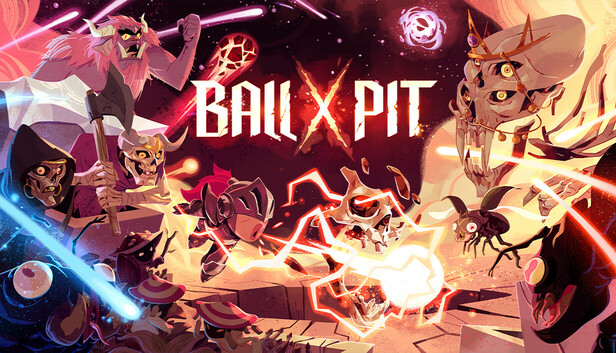
BALL x PIT connects real-time ricochet combat with rebuilding a settlement, making both sides share the same playful physical logic. Fusing abilities and evolving particular combinations give experimentation more substance than chasing bigger damage numbers. Busy effects can make readability a consideration, and its repeat-run appeal depends on enjoying the combinations rather than simply losing hours. It suits players who like adapting builds while the action refuses to wait politely for the next decision.
BALL x PIT combines ricocheting projectiles, monster-filled expeditions and rebuilding a settlement. Released on October 15, 2025, Kenny Sun and Friends' single-player roguelite makes municipal recovery look unusually hazardous. The city is called Ballbylon, so anyone arriving in search of restrained wordplay has already taken a wrong turn.
Fusion, evolution and a readable mess
The important distinction is between fusion and evolution. Sun explains that fusion combines balls' abilities, whereas particular combinations can evolve into a new, stronger ball that can itself be fused again. That is a better invitation to experiment than simply collecting a succession of larger damage numbers. You are looking for interactions, not just replacements. His account of the design also explains why rebuilding the settlement does not have to feel like opening an unrelated spreadsheet between expeditions. Buildings became the equivalent of bricks, with characters bouncing around to improve them. The same physical joke carries from fighting into development, where the workforce apparently has excellent elasticity and a questionable health-and-safety policy. Sun describes moving the early prototype from turn-based play to real-time action after playing Vampire Survivors. That history helps explain the combination: planning a useful mixture of effects happens inside a game that refuses to wait politely for you to finish thinking.
Making that mixture legible was its own design problem. In the team's launch discussion, artist Mohammed Bakir described finding a balance between detail and pixel density, while Sergio Alcelay explained the difficulty of keeping the base's buildings visually consistent as they rotated. Effects artist Fernando Labarta singled out stacking different enemy conditions, such as burning and poisoning, as a challenge. These details matter because a busy screen is not automatically an informative one. The appealing target is a display where the accumulation of effects communicates what your build is doing, rather than merely proving that the graphics hardware has been asked a lot of questions. The artists' comments establish the work behind that target, not a guarantee that every player will find every late-run situation easy to read.
New balls with different trade-offs
The Shadow update adds some particularly telling trade-offs. Its Sniper shots pierce enemies but disappear on a wall hit or return, exchanging staying power for a higher critical chance. Argent Stopwatch begins with increased damage and loses strength with each bounce. Both ideas complicate the natural assumption that a ball bouncing for longer must always be better. Sometimes the valuable action is the first clean line through a group, not the longest possible pinball holiday. That gives aim and positioning a reason to matter alongside the pleasure of multiplying effects. These are not merely extra colours for the same projectile: their limits ask you to think about when damage happens and what an apparently successful bounce might cost.
The later, shipped Naturalist update offers a different pair of examples. Flesh starts weak and accelerates with repeated bounces, while Mosquito Kingdom produces insects that seek weaker targets and can return a little health when they land a killing blow. The first rewards keeping something active; the second ties recovery to finishing off vulnerable enemies. Those are different reasons to value what is happening across the field. They also illustrate why adding another ball can be more interesting than simply increasing the total on a feature list. The question becomes what a new effect encourages you to build around. One wants time to gather momentum, the other wants an opportunity to finish dinner. Neither is just an existing attack wearing a novelty hat.
Replayability is not the same as compulsion
There is a useful caution in Sun's post-launch interview with The Escapist. He expressed mixed feelings about success being described in terms of compulsion and dopamine, rather than treating those words as uncomplicated praise. That is a sensible distinction for anyone deciding what they want from a repeatable game. Losing track of an evening is not, by itself, evidence that the evening was well spent. The relevant appeal is discovering a combination you understand and want to explore, not collecting hours as though they were a prize category. Sun's ambivalence does not settle whether the game will hold your attention in a satisfying way, but it offers a welcome alternative to congratulating every compulsive habit for having excellent retention figures.
The expansion is a future purchase
One boundary matters when assessing the package today: Risen Ballbylon is an announced paid expansion scheduled for November 12, 2026, not content already included at this October source check. Its announcement says access requires finishing the base game. Treat that as a future possibility, and judge the current game rather than buy it on credit against a trailer's promises.
SteamDeveloper design notesArtist discussionShadow mechanicsNaturalist releaseCreator interviewExpansion announcementShadow releaseExpansion status