Quick Review
Baby Steps makes walking a skill again, asking you to place individual feet and read terrain instead of holding forward. Small improvements feel meaningful, while awkward conversations and reactive music give its ungainly hike personality. Uneven challenges, camera trouble and falls that erase substantial progress make frustration central to the experience. Choose it if patient physical practice and exploratory route-finding sound rewarding; enjoying a funny tumble alone may not justify climbing back up.
In this review
Introduction • Reasons to look closer • Learn the surface before blaming the foot • A different route can be the better argument • A funny fall can still waste your evening • The conversation is awkward for a reason • Take the walk on terms you can actually enjoy • Sources
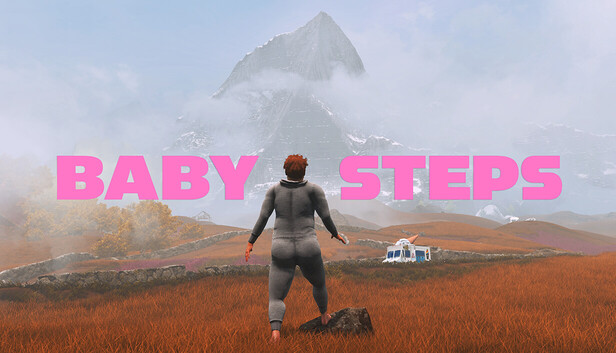
Baby Steps makes a persuasive case that walking has been enjoying far too much automation. Nate, an unemployed man in a onesie, finds himself in a strange wilderness with a mountain to climb and a body that requires supervision. The September 2025 release [1] from Gabe Cuzzillo, Maxi Boch and Bennett Foddy hands each footstep back to the player. Getting somewhere is no longer the interval between interesting activities. It is the activity, and the pavement would like a meeting.
That tiny change has large consequences. A slope becomes a judgement call, a stable position feels valuable, and a stumble can undo a great deal of optimistic planning. The comedy helps, but it doesn't cancel the demand. Choose this because learning an awkward physical skill sounds intriguing, not because a clip of somebody falling looked briefly amusing.
Reasons to look closer
Few adventures make such a familiar action feel worth examining. Manually steering Nate's legs turns terrain into something to read closely, while odd encounters and a reactive soundtrack give the hike a personality beyond its difficulty. The premise is ridiculous enough to invite laughter without needing a scoreboard to justify the journey. It is particularly appealing if you enjoy practising a physical system and setting your own small goals. Successfully getting over that rock is allowed to be the achievement for the evening.
Learn the surface before blaming the foot
The control idea is specific: lift an individual foot, choose its position and put it down while managing your balance. Developer Maxi Boch's explanation [2] describes a progression from taking one step to understanding obstacles and finding a walking rhythm. Different surfaces are physically simulated, so the shape and placement of your next foothold matter. This is a system to learn rather than an animation you trigger by holding forward.
The benefit is that small improvements can be meaningful. Better judgement about where to stand has an immediate application, without waiting for a character upgrade to announce that you are stronger. The demand is continuous attention to things most games make effortless. A person who enjoys careful movement may find that absorbing; someone who regards navigation as the price of reaching the actual game may find it exhausting. Neither reaction is a failure to understand the joke. The joke has asked you to operate two legs, and you are entitled to read the job description.
Turnip Mountain review — climbing with independently controlled arms, including a shared-body local co-op option.A different route can be the better argument
The world gives you room to reconsider an ascent instead of treating every obstacle as a single compulsory test. In an interview published after launch [3], Cuzzillo explains that another direction or something else to explore can often lead back towards the destination. That is an important release valve: persistence needn't always mean repeating precisely the same unsuccessful idea with a more determined expression.
The freedom creates uncertainty too. Spotting a possible route is not the same as knowing whether it is sensible, and an awkward first attempt doesn't tell you whether the path or your technique is the problem. Looking around is therefore part of the skill. The attractive version of this is a journey driven by your own decisions; the frustrating version is investing heavily in an approach you later wish you had abandoned. Bring a willingness to experiment, and occasionally to retreat. A mountain is a poor audience for a sunk-cost argument.
A funny fall can still waste your evening
The biggest reservation is the relationship between difficulty and lost progress. GamesRadar's review [4] praises the walking itself while criticising uneven challenges, occasional camera trouble and the distance a bad fall can send you backwards. Those complaints matter because the same physical commitment that makes an ascent satisfying makes repeating it a real demand on your patience.
There is no universal point at which slapstick stops being funny. Sometimes a spectacular failure is its own reward; sometimes it is just the thing standing between you and finishing before bed. The game's unusual premise doesn't exempt it from that distinction. If you enjoy difficult games primarily for quick retries, be careful about assuming the pleasure transfers. Here, recovering your position may be part of the challenge. That can create a memorable journey, but it can also turn one misplaced foot into a substantial administrative delay. Laughing at Nate and wanting the controller back are not always the same emotion. A funny clip can show you the joke; the buying question is whether you also want the work of getting him back up the slope.
The conversation is awkward for a reason
Nate's discomfort with other people gives the physical comedy another dimension. PC Gamer highlights his repeated refusal of help [5] and the dialogue's ability to remain engaging when another tumble has lost its novelty. His problems don't begin and end with balance. Being offered useful assistance can become its own obstacle when accepting it would mean admitting that things are going badly.
That is a sharper character premise than simply placing a foolish-looking body in a physics engine. It lets the hiking and the conversations share a concern with vulnerability, even when the immediate business is deeply silly. The humour will work best if you enjoy discomfort, digression and a protagonist who can be his own least useful companion. Players wanting a confident hero who efficiently accepts a quest may find the social exchanges as trying as the slopes. Nate has not arrived to demonstrate excellent personal development on a convenient schedule, and the mountain has declined to supply one.
Take the walk on terms you can actually enjoy
The practical options deserve a look before the climb. PlayStation lists control remapping, stick-sensitivity adjustments, large subtitles and optional trigger resistance [6], alongside other settings. These can make the inputs and presentation more comfortable without pretending the underlying coordination challenge disappears. The same listing describes a soundtrack that responds to movement, giving the surroundings another way to participate in the journey rather than simply decorate it.
Baby Steps is a strong choice for a particular mood: curious, unhurried and willing to let an ungainly action become a learned skill. Its originality and character give the effort a purpose beyond proving you can tolerate inconvenience. Still, the frustration is substantial enough to shape the buying decision, not become a footnote beneath the funny screenshots. Come for the strange hike if making gradual physical progress sounds rewarding. If you mainly want the jokes, there is no shame in admitting that someone else's legs may be better suited to the assignment.
Sources
Source links correspond to the numbered references in this review.
[1] Steam — release date, creators, publisher, Windows requirements and single-player mode • [2] PlayStation Blog — developer Maxi Boch on walking, terrain and narrative design • [3] GamesRadar+ — post-launch interview with the developers about difficulty and alternate routes • [4] GamesRadar+ — review of walking, camera and progress-loss trade-offs • [5] PC Gamer — review by Jody Macgregor, 23 September 2025 • [6] PlayStation — PS5 availability, single-player mode, soundtrack and accessibility settings • [7] Devolver Digital press release — launch on PC and PS5, 23 September 2025 • [8] Official game website — released PC and PS5 editions