Quick Review
Afterlove EP follows a grieving musician back into Jakarta's friendships, rehearsals and everyday routines, mixing daily choices with dialogue and musical interludes. Its strongest notes are the specific setting, warm soundtrack and friends whose needs do not vanish around the protagonist. Uneven emotional transitions, limited choices and awkward rhythm sections hold the blend back. Patient fans of character-led stories should find worthwhile company here, but dedicated rhythm players should temper expectations.
In this review
Reasons to look closer · A month is a schedule, not a cure · Jakarta deserves more than a loading-screen postcard · Listening is more interesting than choosing the correct answer · A good soundtrack is not automatically a good note chart · The verdict: worth hearing, even when the parts clash · Sources
Getting a band together is difficult enough before anybody brings a year of unresolved feelings to rehearsal. Afterlove EP makes that awkward room its home. Rama, a musician in Jakarta, is trying to reconnect with life after the death of his girlfriend, Cinta. His friends want him back, his band needs new material, and Cinta’s voice still accompanies him. That is the deliberately uncertain premise [2]: the game does not begin by neatly explaining whether she is a spirit or part of his imagination.
Pikselnesia’s February 14, 2025 release [1] combines a dialogue-heavy adventure with daily scheduling, possible romance and musical interludes. The interesting work happens between people: choosing whom to see, listening to what they need and discovering that a return to normal cannot simply be booked alongside the next gig. Its weaker moments come when those different interactions do not quite join up.
Reasons to look closer
Look closer if you enjoy character-led games that treat ordinary places and conversations as worth your attention. The sense of place is strong here: Jakarta, the hand-drawn presentation and a real Indonesian band’s music give Afterlove EP an identity beyond its sad premise. It is spending time with an imperfect person whose friends have lives of their own. Expect warmth and friction, rather than a tidy emotional service where everybody leaves with their paperwork stamped.
A month is a schedule, not a cure
The 28-day-and-night structure [4] puts a practical boundary around Rama’s return. A significant performance is approaching, and his bandmates cannot keep waiting indefinitely for the songs he has promised. That deadline is useful because it gives the story forward movement without making grief itself a problem with a sensible completion date. There is a meaningful distinction between someone needing support and everyone around that person being required to put their own ambitions into permanent storage. The rehearsal room makes that distinction uncomfortable.
Rama’s daily choices are modest rather than sprawling. You decide which people or activities receive his attention, with music practice punctuating the routine. Shacknews especially praised the strained band relationships [7], including the reminder that Adit and Tasya had responsibilities while Rama withdrew. That is a stronger source of drama than a generic inspirational comeback. A friend can care about you and still be thoroughly tired of your behaviour. Afterlove EP is most persuasive when it lets both things be true without appointing one person the designated villain.
Jakarta deserves more than a loading-screen postcard
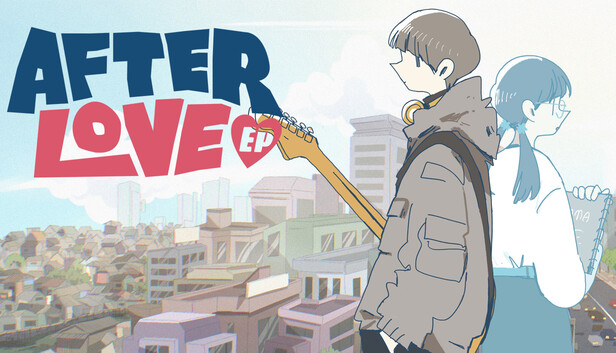
Soyatu’s manga-influenced artwork and L’alphalpha’s original music are central parts of the game’s identity [3], not optional decorative extras. The city supplies places to meet, eat, browse and remember, making Rama’s small routines feel attached to an actual community. The side-scrolling exploration is a useful change from a visual novel’s stationary backdrop: moving between encounters gives conversations a little breathing room.
There is also pleasure in a setting that is not constantly explaining itself for an imaginary tourist. Nintendo Life highlighted details such as local language and Grab drivers [5], alongside the illustrated panels and humid-looking night scenes. These touches make the everyday environment legible without turning every conversation into a cultural information board. The result suits a story about rejoining ordinary life. The city should feel like somewhere that continued existing while Rama struggled, not a handsome waiting room constructed entirely around his personal development.
Listening is more interesting than choosing the correct answer
The phone and map help organise meetings, but the relationships are the substance. New acquaintances include people with their own creative work, insecurities and romantic possibilities; existing friendships carry history that an agreeable response cannot instantly repair. RPGFan found the individual character writing engaging [6] while questioning how often dialogue options meaningfully differed. That is an important limit on the game’s appeal. You are participating in a largely authored story, not running a social simulation with endless ways to improvise your way out of an uncomfortable conversation.
The romance adds another way for Rama’s future to take shape, although its fit is not always graceful. Nintendo Life found the transitions between dating, therapy and band arguments uneven [5]. The issue is not that a bereaved character must follow somebody else’s approved timetable before forming a connection. It is whether the writing makes those changing emotional states feel connected. A calendar can put two scenes next to one another; it cannot supply the missing bridge. Afterlove EP sometimes asks the player to do that emotional carpentry.
A good soundtrack is not automatically a good note chart
The musical sections give the band something to do besides discuss why being in the band is difficult. Button-timing sequences and lyric-related activities interrupt the reading, while the songs provide a shared creative object for the characters to care about. Here, L’alphalpha supplies the original soundtrack [4]. The instrumental warmth gives the surrounding tension something to rub against, rather than turning every scene into a solemn announcement that feelings are occurring.
The inputs are less convincing than the songs. RPGFan criticised the basic rhythm system and its occasionally unclear relationship to the music [6]; Nintendo Life also questioned the timing. These are useful cautions for anyone arriving primarily for the rhythm-game label. The interludes work better as punctuation within a narrative than as its main mechanical attraction. That is not fatal, but it does leave the genre blend lopsided. A compelling song can carry a scene; it cannot make an awkward button prompt secretly become a brilliant one.
The verdict: worth hearing, even when the parts clash
There is room for genuinely different reactions to this story. Shacknews found its uncomfortable friendships cathartic [7], while RPGFan was less convinced by repeated conflict and the way the parts fit together. That disagreement is a useful reminder that video game reviews can value the same uncomfortable scene differently. A recognisably difficult relationship can also become tiring to watch. The useful question is whether patient character observation is enough of a reward for you, even when the pacing wanders. Afterlove EP offers that kind of engagement more readily than polished dramatic escalation or consistently satisfying mechanical choices.
Its existence also carries a real history: Pikselnesia completed the project after creator Mohammad Fahmi’s death in 2022 [2]. That deserves acknowledgement without becoming a reason to ignore the game’s unevenness. The recommendation is for readers drawn to music, place and complicated friendship, who can accept a modest interactive framework and some awkward tonal joins. It is less suitable if you want rhythm-game precision or a densely branching life simulator. The band does not always play perfectly together, but the people making the noise are worth paying attention to.
Sources
Source links correspond to the numbered references in this review.
[1] Steam — official release date, developer, publisher, Windows and single-player details • [2] Fellow Traveller — official premise, released platforms and development background • [3] PlayStation Store — PS5 release, genre, Soyatu and L’alphalpha credits • [4] Xbox Store — Series X|S release, 28-day structure and soundtrack credits • [5] Nintendo Life — Michelle See-Tho’s full Switch review, February 13, 2025 • [6] RPGFan — Paul Skevington’s full review, February 13, 2025 • [7] Shacknews — Lexi Luddy’s full review, February 13, 2025